PreventionWeb
Menu
Reports and analysis
Author(s) Masaharu Nagae Eiko Nagano

Long-term effects of the Kumamoto earthquake on young children’s mental health

Source
Healthcare (MDPI)

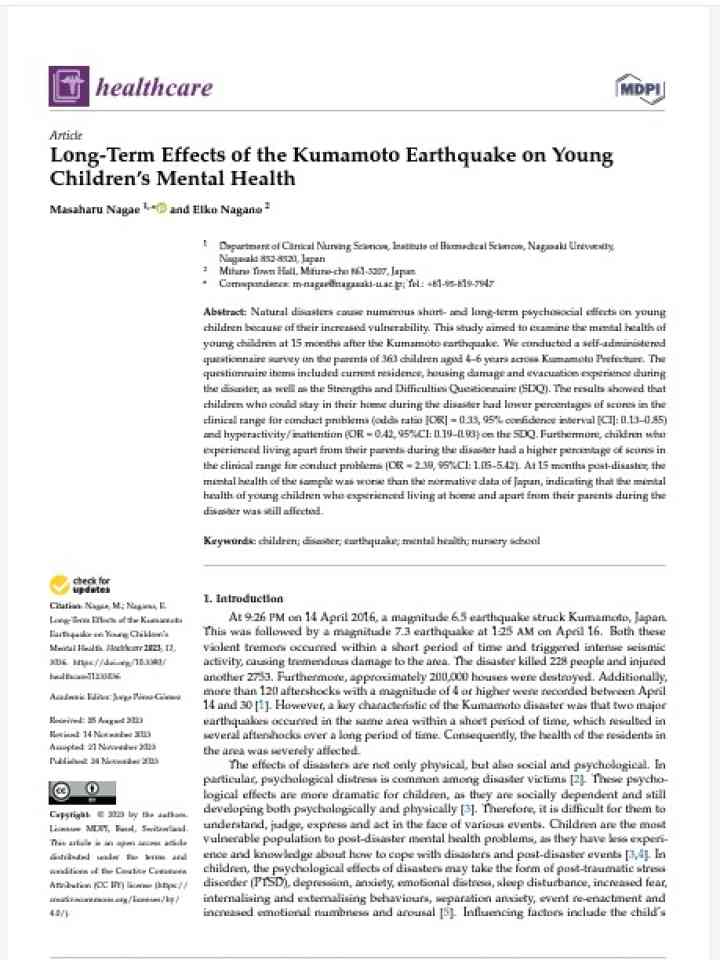
Natural disasters cause numerous short- and long-term psychosocial effects on young children because of their increased vulnerability. This study aimed to examine the mental health of young children at 15 months after the Kumamoto earthquake. We conducted a self-administered questionnaire survey on the parents of 363 children aged 4–6 years across Kumamoto Prefecture. The questionnaire items included current residence, housing damage and evacuation experience during the disaster, as well as the Strengths and Difficulties Questionnaire (SDQ).

The results showed that children who could stay in their home during the disaster had lower percentages of scores in the clinical range for conduct problems and hyperactivity/inattention on the SDQ. Furthermore, children who experienced living apart from their parents during the disaster had a higher percentage of scores in the clinical range for conduct problems. At 15 months post-disaster, the mental health of the sample was worse than the normative data of Japan, indicating that the mental health of young children who experienced living at home and apart from their parents during the disaster was still affected.

Download

Long-Term Effects of the Kumamoto Earthquake on Young Children’s Mental Health PDF, 0.2 MB English

Last checked: 9 December 2024

Editors' recommendations

  • Residential preference transitions of disaster victims: A case using three-wave panel data in Mashiki following the 2016 Kumamoto earthquake in Japan
  • Road to Recovery: Responding to children’s mental health in conflict
  • Coastal exposure and residents’ mental health in the afected areas by the 2011 Great East Japan Earthquake and Tsunami

Explore further

Hazards Earthquake
Themes Children and Youth Health and health facilities Recovery
Country and region Japan
Cover_Healthcare(MDPI)
ISBN/ISSN/DOI
10.3390/healthcare11233036 (DOI)
Number of pages
11 p.
Publication year
2023

Also featured on

UNDRR Website

Is this page useful?

Yes No
Report an issue on this page

Thank you. If you have 2 minutes, we would benefit from additional feedback (link opens in a new window).

The International Recovery Platform (IRP) is a global partnership working to strengthen knowledge, and share experiences and lessons on building back better in recovery, rehabilitation, and reconstruction.

Latest IRP videos and photos: YouTube Flickr Contact IRP

Loading