PreventionWeb
Menu
Case StudyPublications

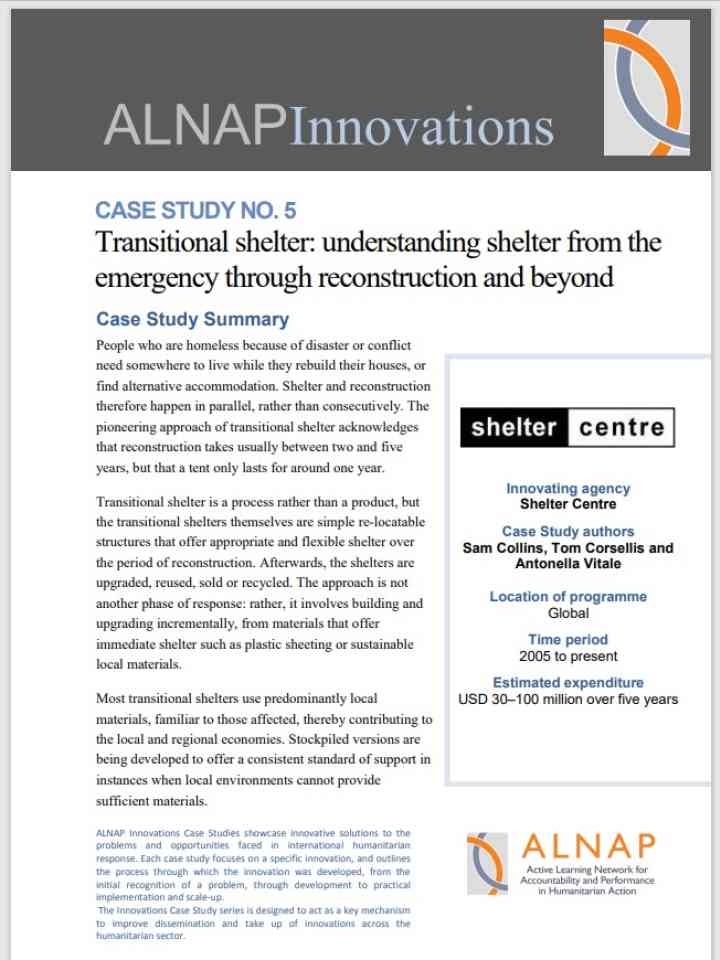
Transitional shelter: understanding shelter from the emergency through reconstruction and beyond

Source
Active Learning Network for Accountability and Performance (ALNAP)

People who are homeless because of disaster or conflict need somewhere to live while they rebuild their houses, or find alternative accommodation. Shelter and reconstruction therefore happen in parallel, rather than consecutively.

Shelter Centre introduced the transitional-shelter approach in 2005, as part of secondments through DFID to UNHCR in Sri Lanka and UN OCHA in Indonesia. This was in support of the governments concerned agreeing and coordinating the implementation of policies in response to the Indian Ocean earthquake and tsunami of December 2004.

Since 2005, agencies and governments worldwide have used the transitional-shelter approach to accommodate millions of people affected by both conflicts and disasters, from Kenya to Indonesia. 

Download

Transitional shelter: understanding shelter from the emergency through reconstruction and beyond PDF, 0.7 MB English

Last checked: 26 July 2024

Editors' recommendations

  • Shelter after disaster: Strategies for transitional settlement and reconstruction
  • Post-Sidr Family Shelter Reconstruction Bangladesh
  • Transitional shelter in post-disaster contexts

Explore further

Themes Recovery Shelter and housing
Transitional shelter: understanding shelter from the emergency through reconstruction and beyond
Number of pages
15 p.
Publication year
2014

Is this page useful?

Yes No
Report an issue on this page

Thank you. If you have 2 minutes, we would benefit from additional feedback (link opens in a new window).

The International Recovery Platform (IRP) is a global partnership working to strengthen knowledge, and share experiences and lessons on building back better in recovery, rehabilitation, and reconstruction.

Latest IRP videos and photos: YouTube Flickr Contact IRP

Loading