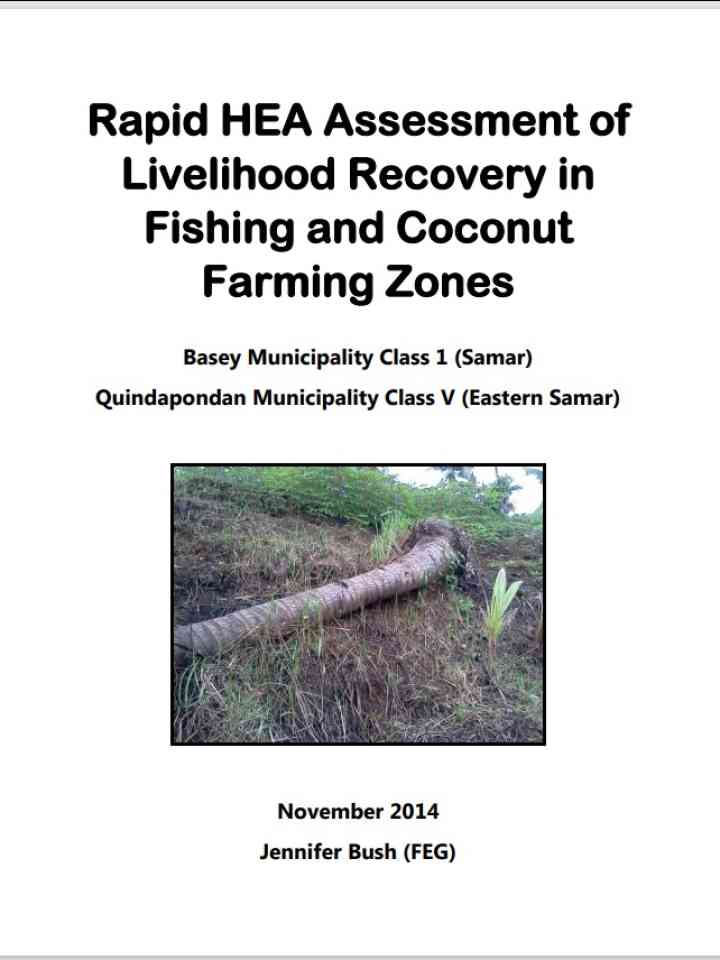
Rapid HEA Assessment of Livelihood Recovery in Fishing and Coconut Farming Zones
The objective of the assessment was to nvestigate how pre-existing livelihood/economic conditions across two different municipal classes may relate to coping in Yolanda-stricken areas, and how these conditions may possibly continue to relate to longer-term recovery, and to undertake the comparison of livelihood data to determine any meaningful difference between the different areas in terms of the impact of the typhoon on the livelihoods of the very poor, and recovery.
The Household Economy Approach (HEA) was used to investigate the research question. HEA is a systematic investigation of food, income and expenditure patterns of different wealth groups in a particular reference year. HEA analysis also includes an assessment of how current year prices and production outcomes will affect food and income access in the upcoming year.
16 different barangays (communities) were selected from 2 different livelihood zones. The research inquiry involved two different comparisons, namely:
(i) The very poor in a lowland fishing zone in four Class I villages (Basey Municipality, Samar) and in four Class V villages (Quindapondan Municipality, Eastern Samar), and
(ii) The very poor in an upland coconut farming zone in four Class I villages (Basey Municipality, Samar) and in four Class V villages (Quindapondan Municipality, E.Samar).
Explore further