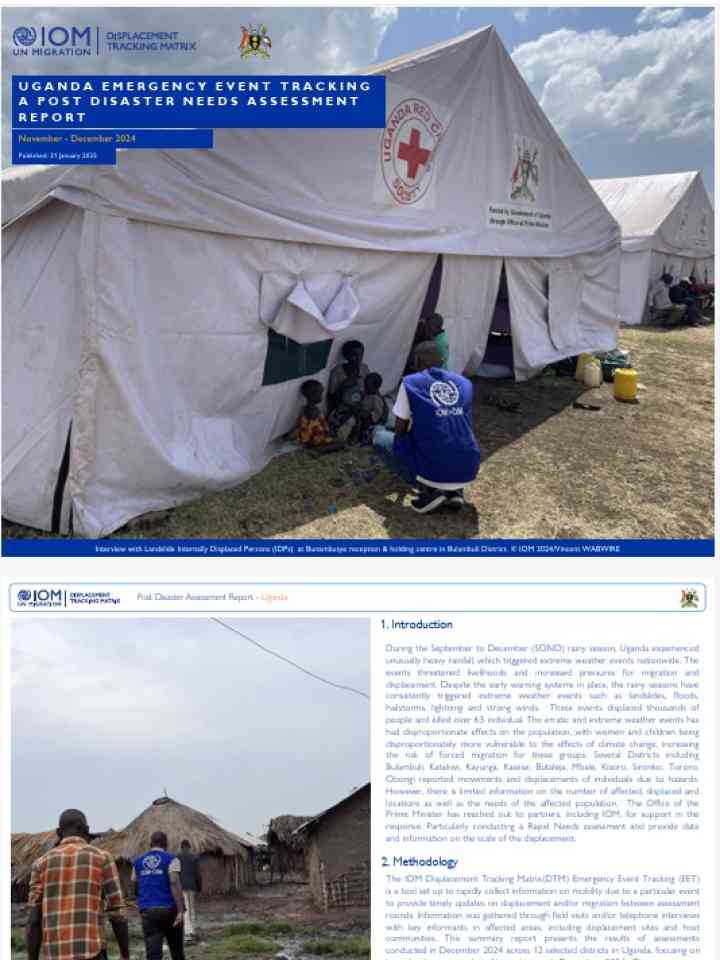
Uganda Emergency Event Tracking - A Post Disaster Needs Assessment Report, November-December 2024
The November-December 2024 Post-Disaster Needs Assessment Report for Uganda, conducted by the International Organization for Migration (IOM) Displacement Tracking Matrix (DTM), highlights the impacts of extreme weather events during the September-December rainy season. These events caused widespread displacement, fatalities, and destruction across 12 districts, including Bulambuli, Kasese, Kayunga, and Kisoro. The assessment utilized field visits and telephone interviews with key informants to collect data on affected populations, internally displaced persons (IDPs), priority needs, and the extent of damage to infrastructure, agriculture, health, and education sectors. Despite early warning systems, heavy rains triggered floods, landslides, hailstorms, and strong winds that displaced over 10,000 households and killed 63 individuals.
The report reveals significant impacts across multiple sectors. In agriculture, crops such as bananas, coffee, maize, and sugarcane were destroyed in districts like Bulambuli and Kasese. Health facilities in Kasese and Bulambuli were damaged, while housing infrastructure saw extensive destruction in areas like Kayunga and Kisoro. Water sources such as wells and latrines were affected in districts like Namisindwa and Kasese, compromising sanitation. Education was disrupted with schools damaged in Kasese and Sironko. Additionally, roads and bridges were severely impacted in districts such as Kasese and Bulambuli. The displaced populations sought refuge in camps or with relatives in safer areas, with Bulambuli hosting IDPs at Bunabutye camp managed by the government.
The report outlines relief efforts provided by various agencies, including food distribution by the Office of the Prime Minister (OPM), shelter assistance from UNICEF and UNHCR, medical screening by UNFPA, and WASH support from UNICEF. Despite these interventions, priority needs remain significant across districts. These include food security, housing reconstruction, road rehabilitation, sanitation improvements, health services restoration, and capacity building at local levels to enhance disaster response. For example, Kasese requires urgent road repairs and bridge reconstruction while Bulambuli needs transportation for IDPs and camp management support. The findings emphasize the need for coordinated efforts to address immediate needs and build resilience against future disasters.
Explore further