These guides support a consistent and coherent approach to the post-disaster assessment, provide an objective and comprehensive estimate of recovery needs, while facilitating quick decision-making and action
This guideline illustrates how to derive financial needs for recovery and reconstruction, following a sector by sector damage and loss assessment. It also explains how to formulate a calendar of investments and identify distribution channels for funding.
World Bank, the
Global Facility for Disaster Reduction and Recovery, the (GFDRR)
Volume 2 guides the sectoral assessment team through the steps of conducting a Damage and Loss Assessment (DaLA). It describes simplified procedures for estimating the value of destroyed physical assets and changes or losses in the flows in the economy.
World Bank, the
Global Facility for Disaster Reduction and Recovery, the (GFDRR)
This guideline supports World Bank Task Team Leaders (TTLs) with the design and execution of assessments to determine disaster impacts and post-disaster needs for recovery, reconstruction and disaster risk reduction.
World Bank, the
Global Facility for Disaster Reduction and Recovery, the (GFDRR)
This document mainstreams the methodology for disaster damage and loss assessment (DaLA), providing material for training programs to build capacity for damage and loss assessments at national, regional and local levels as well as for critical sectors.
World Bank, the
Global Facility for Disaster Reduction and Recovery, the (GFDRR)
The overall objective of this SOP is to provide guidance/better understanding of a mechanism required to undertake a systematic and harmonized WASH Sector PDNA after a disaster event, by the Government of Fiji.
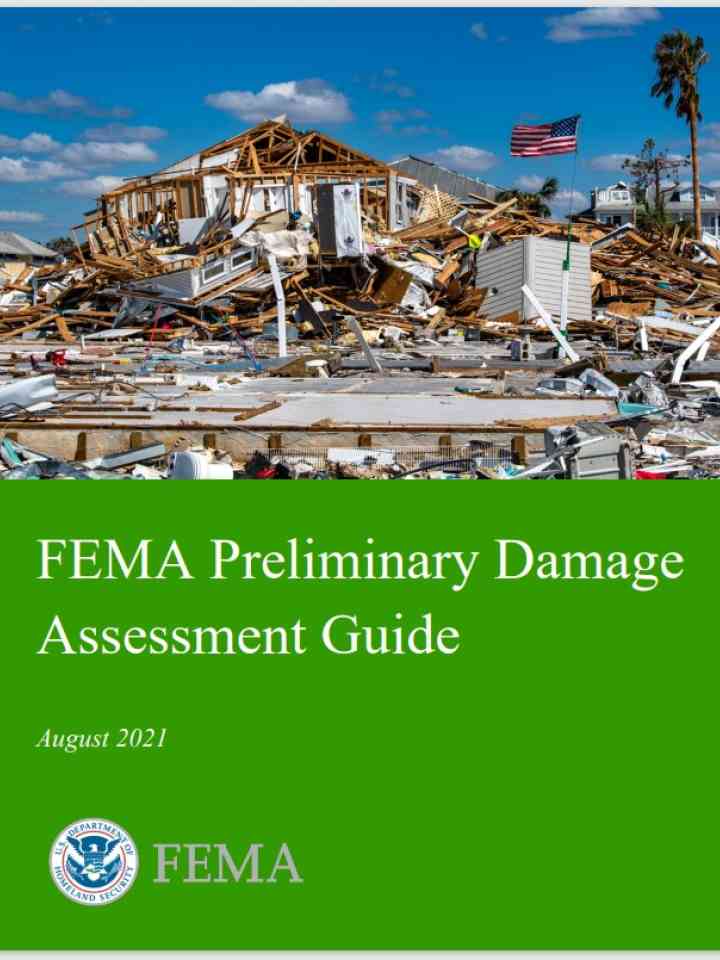
The Preliminary Damage Assessment Guide (PDA Guide) is a standard framework for how emergency management officials conduct preliminary damage assessments (PDAs) following a disaster and was effective starting Oct. 1, 2021.
This Standard Operating Procedure (SOP) guides the State and its agencies in undertaking a post-disaster needs assessment (PDNA) and in developing a recovery and reconstruction plan of actions to build back better
This manual describes how the rapid needs assessment(RNA) process is organized, activated and managed during disasters. It illustrates how assessment information is compiled and disseminated.
This is an introduction to post-disaster needs assessment methodology adapted for Viet Nam, providing insights into disaster management in the country.
This document, Guidelines for Assessing the Human Impact of Disasters, has been developed as part of the PDNA guidelines, and similarly follows a people-centred, human-recovery approach.
This guide explains how to conduct a PDNA in Conflict Situations, and complements existing guidelines developed by the tripartite partnership to support post-disaster needs assessments and recovery planning.
This guidance note was drafted to document lessons learned in the three project countries (Nepal, Sri Lanka, Côte d'Ivoire) and in doing so, it provides a step-by-step practical guide for countries in post-crisis situations to undertake Post-Crisis Integrated Strategic Environmental Assessments (Integrated SEA). The Integrated SEA approach builds upon current SEA practices, while placing greater emphasis on integrating disaster risk and climate change impacts into a participatory data collection, mapping and planning process.
United Nations Environment Programme (UNEP)
Climate and Pollution Agency, Norwegian Ministry of the Environment