PreventionWeb
Navigation loading…

Navigation failed to load. If you are on the UNDRR office network, your browser may be blocking access to external resources. Learn how to allow access.

Menu
Last updated 1 Mar 2024

Recovery Collection: 2004 Indian Ocean Earthquake and Tsunami
Image
Indian Ocean Tsunami
Frans Delian / Shutterstock

Introduction

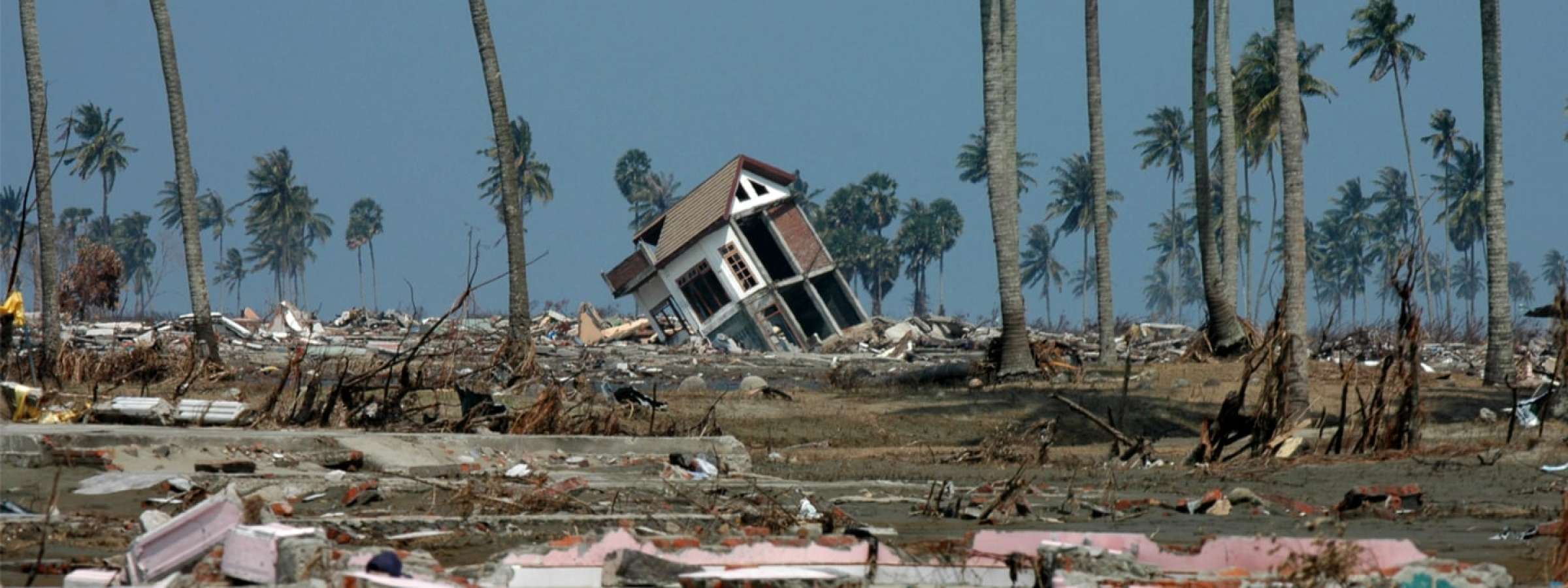
The morning of December 26, 2004 saw the worst disaster in Indonesia’s history. A magnitude (M) 9.1 submarine earthquake occurred along the Indian Ocean subduction zone triggering a massive tsunami that destroyed 800 km of the coastal areas of Aceh Province with inundation observed as far as 6 km inland. Post disaster damage and loss assessment revealed staggering numbers on the calamity that include over 220,000 human fatalities and the destruction of 139,000 houses, 73,869 hectares of agricultural lands, 2,618 kilometers of roads, 3,415 schools, 104,500 small-medium enterprises, 13,828 fishing boats, 119 bridges, 669 government buildings, 517 health facilities, 1,089 worship places, 22 seaports, and 8 airports and airstrips (BRR-Agency for the Rehabilitation and Reconstruction of Aceh and Nias, 2009). Added to these statistics, more than half a million tsunami survivors were internally displaced and hundreds of thousands more lost their livelihoods.

Almost within hours, news on the tsunami devastation of Aceh spread quickly around the world eventually sparking an unprecedented massive global community emergency response and relief effort. Given the extremely urgent situation on the grounds, the Government of Indonesia agreed to allow international military personnel coming from Asian and European countries, the United States, and Australia, among others, to participate in the disaster response operations that also included more than 600 local, national, and international non-governmental, community-based, civil society, multi-lateral, and UN organizations. Some of these organizations continued to be involved in the post-tsunami reconstruction and recovery phase. The reconstruction costs were estimated to be US $4.9 billion while committed funds from various sources including the international community donors and the Government of Indonesia amounted to US$ 6.7 billion (BRR, 2009).

Before embarking on a painstaking reconstruction effort, the Government of Indonesia created a “Master Plan for the Rehabilitation and Reconstruction of Aceh and Nias, North Sumatra”. Parallel to this effort, the government also established the Agency for the Rehabilitation and Reconstruction of Aceh and Nias (BRR), an ad-hoc agency, first of its kind, mandated to implement and coordinate government-funded projects and coordinate donor- and NGO- funded projects from April 2005 to April 2009. The “Build Back Better” philosophy was adopted in the reconstruction effort. This guiding principle seeks to ensure that every reconstruction effort shall integrate the concept of Disaster Risk Reduction that would help reduce future disaster risk and build resilience. By the end of the project period, BRR had implemented and coordinated a total of roughly 12,000 projects.

Post-tsunami recovery and reconstruction efforts generally resulted in significant achievements in terms of housing, infrastructure, environment, agriculture, livelihood, health, local economy, education, and disaster management sectors. The enactment of Law of the Republic of Indonesia Number 24/ 2007 concerning Disaster Management and the subsequent transformation of disaster management entities marked a major shift in disaster management paradigm in Indonesia which should help prepare Indonesia in responding more effectively to future disaster events.
Hazards
Earthquake Tsunami
Themes
Critical infrastructure Preparedness Education and school safety Food security and agriculture Livelihood Recovery Shelter and housing
Country and region
Indonesia

Knowledge base

Items: 64
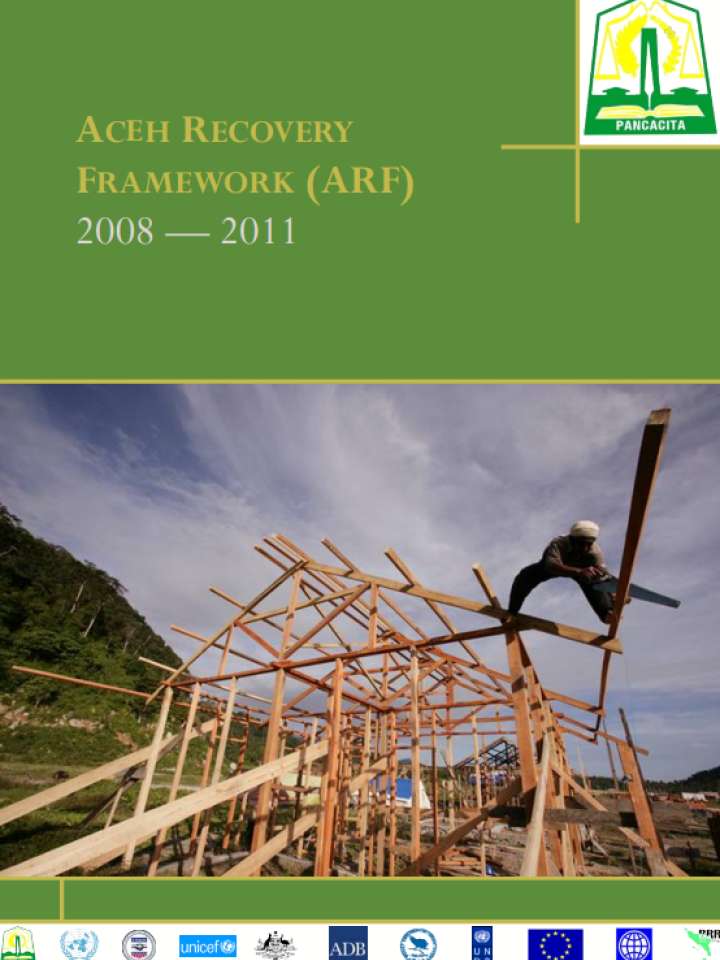
Aceh Recovery Framework (ARF) 2008-2011
Documents and publications
DRF - Disaster Recovery Frameworks
20 May 2009
Aceh recovery framework (ARF) 2008-2011

This document presents the major challenges in Aceh’s transition and governmental priorities, benchmarks and outcomes in virtually every sector of peace building, recovery and development activity in the aftermath of the 2004 earthquake and tsunami.

Indonesia - government
United Nations - Headquarters
United Nations Children's Fund (UNICEF)
Asian Development Bank (ADB)
United Nations Development Programme (UNDP)
European Union
World Bank, the
United Nations Human Settlements Programme (UN-HABITAT)
Vulnerability in the context of post 2004 Indian Ocean Tsunami recovery: Lessons for building more resilient coastal communities
Documents and publications
Publications
13 March 2009
Vulnerability in the context of post 2004 Indian Ocean Tsunami recovery: Lessons for building more resilient coastal communities

This report provides the insight of relief and recovery efforts after the 2004 Indian Ocean Tsunami in South East Asia are burdened by extreme competitiveness and lack of collective action.

Stockholm Environment Institute
Documents and publications
20 August 2008
Tsunami recovery: taking stock after two years

This report, from the Office of the Secretary-General’s Special Envoy for Tsunami Recovery, former U.S. President Bill Clinton, documents the status of the recovery effort at two years after the occurrence of the earthquake off the coast of Sumatra on December 26, 2004 and the tsunami it triggered.

Office of the Secretary-General's Special Envoy for Tsunami Recovery
Documents and publications
10 August 2008
Plan of operations: Indonesia Component of Forestry Programme for early rehabilitation in Asian tsunami affected countries, OSRO/GLO/502/FIN

This document details the plan of operations for the Indonesian component of OSRO/GLO/502/FIN and has been developed on the basis of the issues and principles identified in the regional project document as well as the prevailing situation in Aceh and Nias one year after the tsunami. The work comprises three results addressing (i) forest rehabilitation, reforestation, tree planting and integrated coastal area management, (ii) timber supply, and (iii) capacity building.

Food and Agriculture Organization of the United Nations (FAO)
Documents and publications
10 August 2008
Tsunami, one year on: a summary of the implementation of the Phuket Action Plan

The Action Plan focuses on aiding the human recovery in the tourism industry in five key areas - marketing and communication, community relief, professional training of the tourism workforce, re-development and repositioning of the tourism product with greater emphasis on sustainability and risk management - a framework for assistance within which WTO would contribute to tourism recovery.

World Tourism Organization (WTO)
Documents and publications
10 August 2008
After the tragedy in the Indian Ocean: a time to remember, reflect and recommit, December 2004 through October 2005

This document is a summary by country of Care's recovery progress achieved in partnership with tsunami-struck communities in the 10 months following the disaster and and future plans.

CARE International
Documents and publications
7 August 2008
The impact of the conflict, the tsunami and reconstruction on poverty in Aceh: Aceh poverty assessment 2008

Three years into the reconstruction effort, with vast amounts of aid having been spent, this reports aims to shed some light on questions regarding the ability of the early relief and reconstruction effort to alleviate poverty in Aceh. This report aims to offer the provincial government in Aceh and the reconstruction agency (BRR) a clearer picture of poverty in the post-conflict and tsunami environment in order to allow them to better design policies and programs to alleviate poverty in the province.

World Bank, the
Documents and publications
5 August 2008
Guidelines for reconstruction of houses affected by tsunami in Tamil Nadu

Consise set of guidelines detailing the reconstruction of housing affected by 2004 Indian Ocean and Tsunami. Main sections include: disaster and effects, construction and planning aspects for resistance against disasters, retrofitting of exiting buildings, repairs and strengthening of buildings.

India - government
Documents and publications
21 July 2008
Moving beyond the tsunami: the WHO story

The tsunami of 2004, one of the worst natural disasters in recent times, hit six countries of the WHO South-East Asia Region. This publication narrates the story of how WHO responded, the tremendous challenges faced, and how they were overcome. Dramatic, poignant photographs, as well as boxes and anecdotes of individuals involved, highlight the very human face of the health sector response to the tragedy.

World Health Organization (WHO)
Documents and publications
21 July 2008
Humanitarian exchange, number 32, December 2005: the tsunami response

This issue of Humanitarian Exchange focuses on the emergency response to the devastation caused by the earthquake and tsunami in the Indian Ocean on 26 December 2004.

Humanitarian Practice Network
ODI Global

Pagination

Showing results 31–40 on this page

  • Previous
  • 1
  • …
  • 3
  • 4
  • 5
  • Next

Is this page useful?

Yes No
Report an issue on this page

Thank you. If you have 2 minutes, we would benefit from additional feedback (link opens in a new window).

The International Recovery Platform (IRP) is a global partnership working to strengthen knowledge, and share experiences and lessons on building back better in recovery, rehabilitation, and reconstruction.

Latest IRP videos and photos: YouTube Flickr Contact IRP

Loading