PreventionWeb
Navigation loading…

Navigation failed to load. If you are on the UNDRR office network, your browser may be blocking access to external resources. Learn how to allow access.

Menu
Last updated 1 Mar 2024

Recovery Collection: 2004 Indian Ocean Earthquake and Tsunami
Image
Indian Ocean Tsunami
Frans Delian / Shutterstock

Introduction

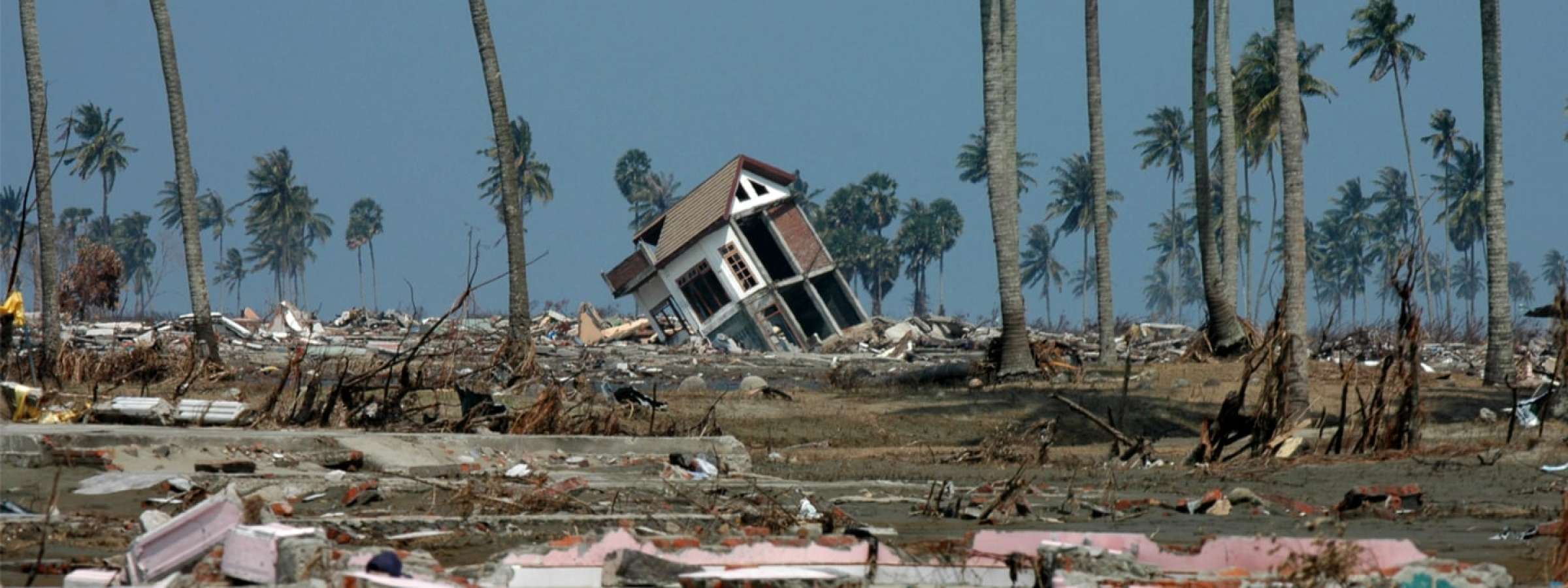
The morning of December 26, 2004 saw the worst disaster in Indonesia’s history. A magnitude (M) 9.1 submarine earthquake occurred along the Indian Ocean subduction zone triggering a massive tsunami that destroyed 800 km of the coastal areas of Aceh Province with inundation observed as far as 6 km inland. Post disaster damage and loss assessment revealed staggering numbers on the calamity that include over 220,000 human fatalities and the destruction of 139,000 houses, 73,869 hectares of agricultural lands, 2,618 kilometers of roads, 3,415 schools, 104,500 small-medium enterprises, 13,828 fishing boats, 119 bridges, 669 government buildings, 517 health facilities, 1,089 worship places, 22 seaports, and 8 airports and airstrips (BRR-Agency for the Rehabilitation and Reconstruction of Aceh and Nias, 2009). Added to these statistics, more than half a million tsunami survivors were internally displaced and hundreds of thousands more lost their livelihoods.

Almost within hours, news on the tsunami devastation of Aceh spread quickly around the world eventually sparking an unprecedented massive global community emergency response and relief effort. Given the extremely urgent situation on the grounds, the Government of Indonesia agreed to allow international military personnel coming from Asian and European countries, the United States, and Australia, among others, to participate in the disaster response operations that also included more than 600 local, national, and international non-governmental, community-based, civil society, multi-lateral, and UN organizations. Some of these organizations continued to be involved in the post-tsunami reconstruction and recovery phase. The reconstruction costs were estimated to be US $4.9 billion while committed funds from various sources including the international community donors and the Government of Indonesia amounted to US$ 6.7 billion (BRR, 2009).

Before embarking on a painstaking reconstruction effort, the Government of Indonesia created a “Master Plan for the Rehabilitation and Reconstruction of Aceh and Nias, North Sumatra”. Parallel to this effort, the government also established the Agency for the Rehabilitation and Reconstruction of Aceh and Nias (BRR), an ad-hoc agency, first of its kind, mandated to implement and coordinate government-funded projects and coordinate donor- and NGO- funded projects from April 2005 to April 2009. The “Build Back Better” philosophy was adopted in the reconstruction effort. This guiding principle seeks to ensure that every reconstruction effort shall integrate the concept of Disaster Risk Reduction that would help reduce future disaster risk and build resilience. By the end of the project period, BRR had implemented and coordinated a total of roughly 12,000 projects.

Post-tsunami recovery and reconstruction efforts generally resulted in significant achievements in terms of housing, infrastructure, environment, agriculture, livelihood, health, local economy, education, and disaster management sectors. The enactment of Law of the Republic of Indonesia Number 24/ 2007 concerning Disaster Management and the subsequent transformation of disaster management entities marked a major shift in disaster management paradigm in Indonesia which should help prepare Indonesia in responding more effectively to future disaster events.
Hazards
Earthquake Tsunami
Themes
Critical infrastructure Preparedness Education and school safety Food security and agriculture Livelihood Recovery Shelter and housing
Country and region
Indonesia

Knowledge base

Items: 64
Documents and publications
10 March 2010
Five years after the tsunami in the Indian Ocean: from strategy to implementation

This document looks at the five years of international cooperation and political will following the 2004 Indian Ocean Tsunami. It draws lessons learned on the development and consolidation of tsunami and other sea level related hazard warning systems, striving to consolidate global coverage and international development, and to include disaster risk reduction initiatives within recovery and reconstruction activities and, more generally, within development strategies.

United Nations Educational, Scientific and Cultural Organization (UNESCO)
Intergovernmental Oceanographic Commission (UNESCO)
Documents and publications
25 January 2010
Lessons from Aceh: key considerations in post-disaster reconstruction

This publication has been created with the intention of capturing key characteristics of the response and lessons learned, in a widely available format. It is intended to provide a valuable reference in future disaster responses. The content is based on the DEC Assurance Mission (Arup, 2007) as well as the authors observations and experiences on previous assignments in Aceh during the post-tsunami response. This is supported by further research and consultation, additional information provided by DEC Member Agencies and other documentation of the response. The views expressed are those of the authors.

Disaster Emergency Committee
Arup International Development
Practical Action
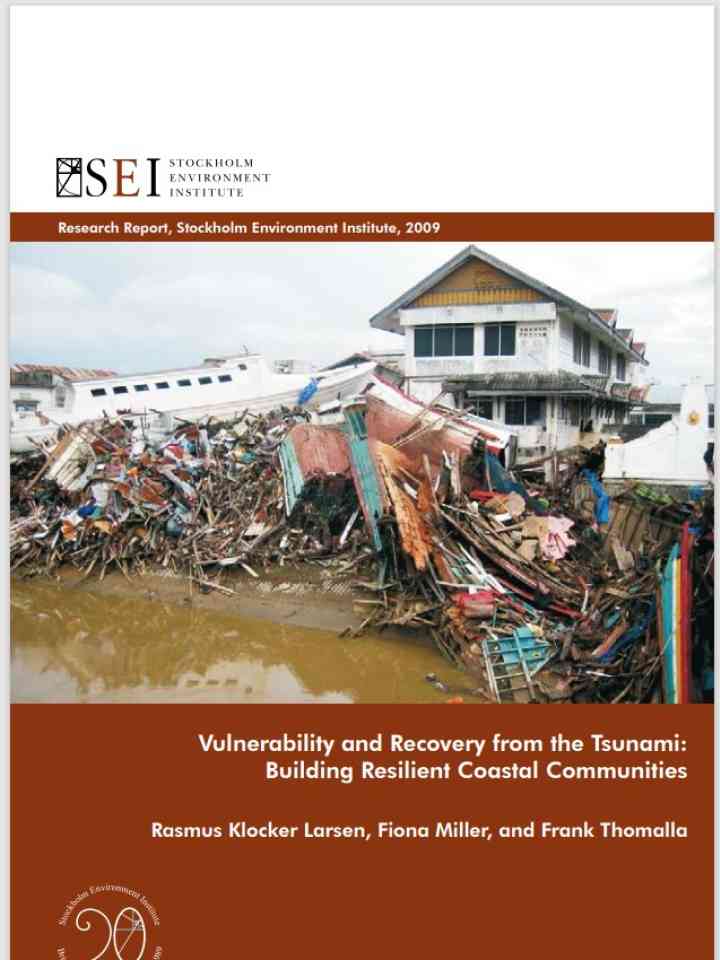
Vulnerability and recovery from the tsunami: building resilient coastal communities: a synthesis of factors contributing to tsunami-related vulnerability in Sri Lanka and Indonesia
Documents and publications
Publications
19 January 2010
Vulnerability and recovery from the tsunami: building resilient coastal communities: a synthesis of factors contributing to tsunami-related vulnerability in Sri Lanka and Indonesia

This report provides a meta-analysis to synthesise insights from the tsunami recovery literature on the key factors contributing to vulnerability to the 2004 Indian Ocean Tsunami and to emerging vulnerabilities related to post-disaster recovery.

Stockholm Environment Institute
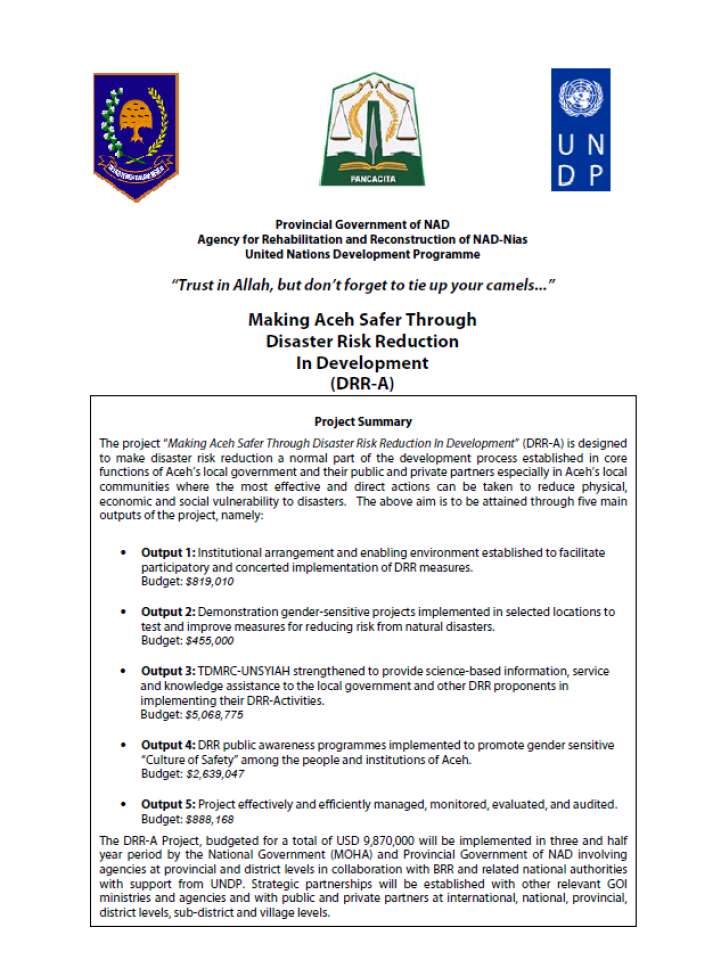
Making Aceh Safer Through Disaster Risk Reduction in Development (DRR-A)
Documents and publications
Publications
1 January 2010
Making Aceh safer through disaster risk reduction In development (DRR-A)

The project “Making Aceh Safer Through Disaster Risk Reduction In Development (DRR-A)” is designed to make DRR a normal part of the development process established in core functions of Aceh’s local government and their public and private partners.

Indonesia - government
Documents and publications
6 December 2009
Tiding over tsunami - part 1

This publication provides a succinct account of the damage caused by the tsunami and its far-reaching impact on the lives and livelihoods of people in coastal Tamil Nadu. The book also documented the speedy decisions and the concerted rescue and relief measures taken by Government of Tamil Nadu and partners.

India - government
Documents and publications
6 December 2009
Tiding over tsunami - part 2

In this publication the Government of Tamil Nadu gives details regarding rehabilitation and the reconstruction programmes undertaken to revive coastal communities affected by the Tsunami in 2004.

India - government
Documents and publications
9 September 2009
The role of the affected state in humanitarian action: a case study on India

This case study is part of the ODI HPG research programme on the role of the affected state in humanitarian action and aims to describe the essential elements of approach to disaster management as seen in its response to the 2001 Gujarat earthquake and the 2004 Indian Ocean tsunami. It also analyses policy trends in Disaster Management Act.

ODI Global
10 Management Lessons for Host Governments Coordinating Post-disaster Reconstruction
Documents and publications
Publications
9 September 2009
10 management lessons for host governments coordinating post-disaster reconstruction

This document contains the ten most important management lessons learned over a period of four years by BRR, the coordinating agency responsible for the reconstruction of Aceh and Nias following the 2004 Indian Ocean tsunami.

Indonesia - government
Documents and publications
2 June 2009
A ripple in development? Long term perspectives on the response to the Indian Ocean tsunami 2004

This report is a follow-up evaluation of linkages between immediate relief, rehabilitation (or reconstruction) and development (LRRD) related to the response to the Indian Ocean tsunami in 2004. The LRRD2 evaluation report covers experiences up to the end of 2008 in Indonesia, Sri Lanka and the Maldives, i.e. from the four years after the disaster. A number of organisations and government agencies have supported this evaluation in various ways, with the aim to provide conclusions and lessons learned that are useful for mitigating the consequences of possible future disasters.

DARA - Spain
Swedish Agency for International Development Cooperation
Post-Tsunami Housing Reconstruction, Kalutara District, Sri Lanka - Final Report & Lessons Learnt
Documents and publications
Case Study
Publications
1 June 2009
Post-Tsunami Housing Reconstruction, Kalutara District, Sri Lanka - Final Report & Lessons Learnt

The post-tsunami housing reconstruction in Kalutara District, Sri Lanka, led by the Belgian Red Cross, focused on building houses and essential infrastructure, empowering beneficiaries through an owner-driven approach.

Belgian Red Cross - Flanders

Pagination

Showing results 21–30 on this page

  • Previous
  • 1
  • 2
  • 3
  • 4
  • Next

Is this page useful?

Yes No
Report an issue on this page

Thank you. If you have 2 minutes, we would benefit from additional feedback (link opens in a new window).

The International Recovery Platform (IRP) is a global partnership working to strengthen knowledge, and share experiences and lessons on building back better in recovery, rehabilitation, and reconstruction.

Latest IRP videos and photos: YouTube Flickr Contact IRP

Loading