PreventionWeb
Menu
Last updated 22 Aug 2011

Recovery Collection: Türkiye: Izmit earthquake 1999
Image
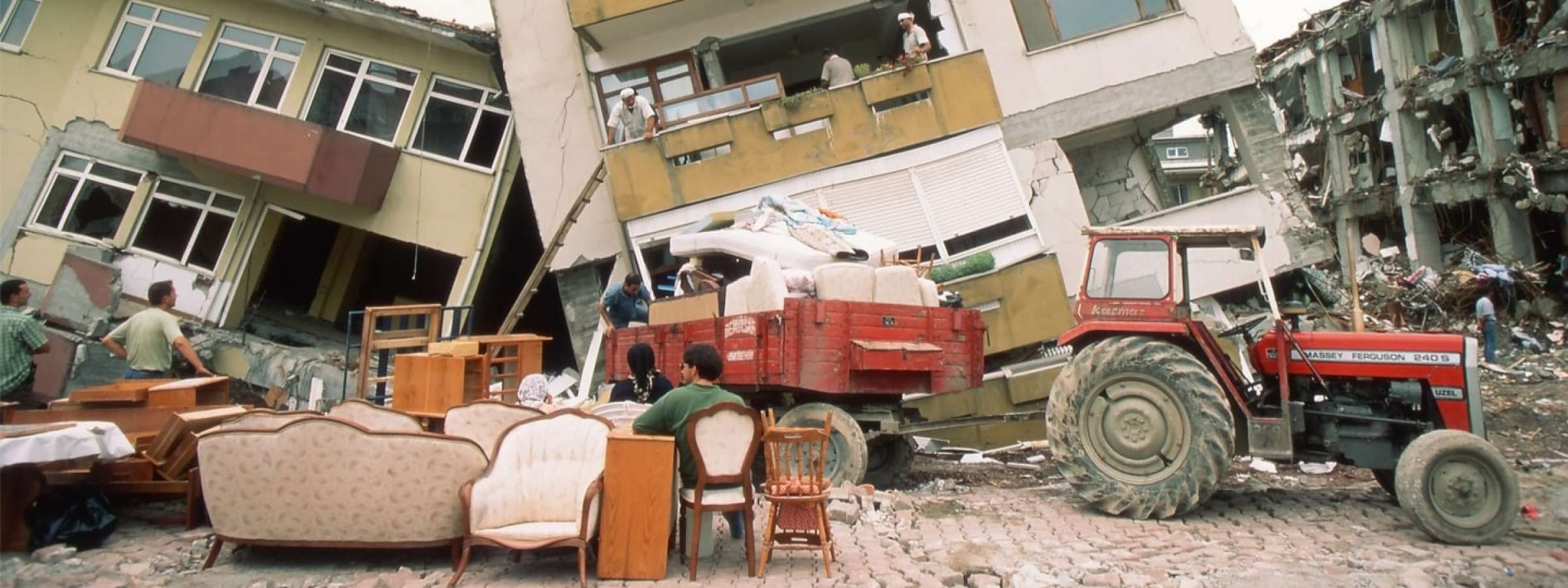
Izmit earthquake
Sadik Gulec / Shutterstock

Introduction

The Izmit Earthquake, also called Kocaeli Earthquake or Golcuk Earthquake, occurred on 17 August 1999. The magnitude 7.4 earthquake, which lasted less than a minute, struck the Anatolian fault system with the epicentre at about 7 miles southeast of Izmit. It was the most damaging earthquake in Türkiye, causing the death of 17,000 people and leaving more than 250,000 people homeless. It was followed by the magnitude 7.2 Duzce Earthquake on 12 November 1999, which also occurred on the North Anatolian Fault and caused at least 845 deaths in Duzce and surrounding areas.

The Izmit earthquake happened in the industrialized and most densely populated urban areas of Istanbul, Sakarya, Golcuk, Darica, and Derince. Reports show that about 120,000 houses were severely damaged due to poor construction. Many bridges and other infrastructure were also damaged. From an economic perspective, the damage was estimated at 23 billion US dollars. In the industrial areas, the earthquake caused a serious fire, which was taken control only after five days. The Izmit Earthquake demonstrated gaps in the capacities of disaster response agencies. A massive international response assisted the wounded and homeless and the overall search and rescue process.

The reconstruction programs included the Turkish government's Earthquake Reconstruction Program and World Bank Comprehensive Framework Program. An important lesson learned following the earthquake was the importance of risk mitigation and preparedness. To achieve this, new building codes were introduced, and related legislation were amended. As rapid and unplanned urbanization was also identified as a risk factor, the "Planned Urbanization and Housing Production Mobilization" strategy was introduced, a compulsory earthquake insurance system implemented, and strengthening of critical public infrastructure, including schools, hospitals, pipes and lifelines, was undertaken. There was an increase in disaster awareness of the public and private sectors and a recognition of the important role of civil society. The gaps in health and medical services were also addressed through psychosocial support programs in response to the needs of disaster survivors experiencing trauma.
Hazards
Earthquake
Themes
Critical infrastructure Recovery Shelter and housing Urban risk and planning
Country and region
Türkiye

Knowledge base

Items: 12
Documents and publications
22 August 2011
The socio-economic consequences of the earthquake at Izmit, Turkey (17 August 1999)

This study examines the economic and social consequences of the 17 August 1999 earthquake, known as the Izmit earthquake, which affected a third of Turkey's total population and caused substantial human and material losses.

United Nations Office for Disaster Risk Reduction (UNDRR)
Documents and publications
Disaster Recovery Guidance
1 January 2010
Guidance note on recovery: telling live lessons

This guidance note shares 'live lessons' learned - told through first-person stories - that contribute to disaster preparedness, mitigation, and a recovery that builds back better.

United Nations Office for Disaster Risk Reduction (UNDRR)
International Recovery Platform
Documents and publications
Publications
21 July 2008
South Asia earthquake 2005: learning from previous earthquake relief operations

This briefing paper provides a synthesis of key lessons learned from relief responses to past earthquakes. The main intended audiences are operational decision-makers and relief programme managers working in the South Asia earthquake relief operation.

ProVention Consortium
Active Learning Network for Accountability and Performance (ALNAP)
Documents and publications
7 July 2008
Global report on human settlements 2007, disaster at a glance: A tale of two cities, economic impacts of the Kobe and Marmara earthquakes

This brief report presents economic Impacts of the Kobe and Marmara Earthquakes.

United Nations Human Settlements Programme (UN-HABITAT)
Documents and publications
7 July 2008
Structural engineering reconnaissance of the August 17, 1999 Kocaeli (Izmit), Turkey, earthquake

This report presents information on the development of building and seismic codes in Turkey, behavior of buildings, and industrial facilities in the epicenter region of Izmit earthquake in 1999.

Pacific Earthquake Engineering Center
Documents and publications
7 July 2008
Event report: Kocaeli, Turkey earthquake

This report documents the event of the Kocaeli Earthquake in Turkey in 1999. In addition to providing background information on the event, this report includes the following sections: the earthquake and its geologic effects, building and infrastructure damage, industrial facilities, and insured and economic losses. The report also includes a section on consequences and future implications.

Risk Management Solutions
Documents and publications
7 July 2008
Izmit Turkey earthquake of August 1999 (M7.4) an EQE briefing

A briefing on the implications of the Izmit Earthquake,Turkey, 1999.

EQECAT
Documents and publications
7 July 2008
Survey report on the reconstruction following the earthquake in Marmara, Turkey on August 17, 1999

This report provides tables with data and statistics documenting damage to infrastructure, an overview of response activities, and inventory of recovery and reconstruction efforts of Marmara Earthquake in 1999.

Asian Disaster Reduction Center
Documents and publications
7 July 2008
Economic effects of the 1999 Turkish earthquakes: an interim report, economics department working papers no. 247

This Working Paper presents a cross-directorate report on the economic, budgetary, regulatory and urban policy implications of the earthquakes which struck the Marmara and Bolu areas of Turkey on 17 August and 12 November 1999. The earthquakes caused high casualties and significant material damage to property, with severe effects on economic activity. The Report traces the factors underlying Turkey’s vulnerability to earthquake damage, along a known active fault line, to deficiencies in risk identification procedures and risk-reduction methods, as well as to the absence of risk transfer and financing techniques. It suggests that these deficiencies may stem from the nature of recent Turkish economic development, which has been driven by the need to assimilate a mass migration from the countryside to the cities and has been associated with extremely high and variable inflation.

Organisation for Economic Co-operation and Development
Documents and publications
Case Study
7 July 2008
The Turkish Red Crescent Society international disaster response law: 1999-Marmara earthquake, case study

National disaster law and policies, regional, bilateral and international agreements, declarations and regulations regarding the disaster response law in Turkey within the framework of the 1999-Marmara Earthquake are discussed in this study.

International Federation of Red Cross and Red Crescent Societies (IFRC)

Pagination

Showing results 1–10 on this page

  • 1
  • 2
  • Next

Is this page useful?

Yes No
Report an issue on this page

Thank you. If you have 2 minutes, we would benefit from additional feedback (link opens in a new window).

The International Recovery Platform (IRP) is a global partnership working to strengthen knowledge, and share experiences and lessons on building back better in recovery, rehabilitation, and reconstruction.

Latest IRP videos and photos: YouTube Flickr Contact IRP

Loading