PDNA guidance

These guides support a consistent and coherent approach to the post-disaster assessment, provide an objective and comprehensive estimate of recovery needs, while facilitating quick decision-making and action

Featured PDNAs

PDNA is a government-led exercise, with integrated support from the United Nations, the European Commission, the World Bank and other national and international actors. A PDNA pulls together information into a single, consolidated report, information on the physical impacts of a disaster, the economic value of the damages and losses, the human impacts as experienced by the affected population, and the resulting early and long-term recovery needs and priorities.

United Nations Development Programme (UNDP)
DLNA Madagascar 2008
Documents and publications
PDNA - Post Disaster Needs Assessments

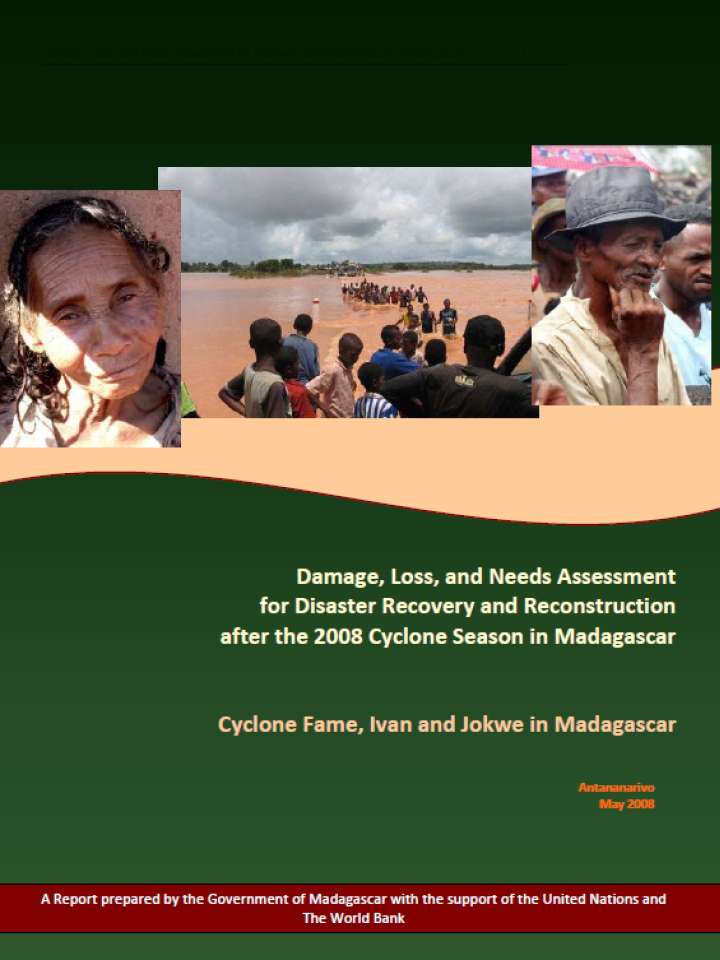
The Government of Madagascar undertook a comprehensive damage and loss and needs assessment to ascertain the extent of the damages caused by the three consecutive cyclones in 2008, and to define a comprehensive and feasible recovery plan.

Madagascar - government
Global Facility for Disaster Reduction and Recovery, the (GFDRR)
United Nations Development Programme (UNDP)
Documents and publications
PDNA - Post Disaster Needs Assessments

The aim of the assessment is to identify priority areas to support the Government of Bangladesh in cyclone recovery efforts as well as to design a disaster management strategy.

Bangladesh - government
World Bank, the
European Commission
International Labour Organization (ILO)
International Federation of Red Cross and Red Crescent Societies (IFRC)
Asian Development Bank (ADB)
United Nations Development Programme (UNDP)
Japan Bank For International Cooperation
Japan International Cooperation Agency
Islamic Development Bank
Food and Agriculture Organization of the United Nations (FAO)
World Food Programme (WFP)
World Health Organization (WHO)
Department for International Development
United States Agency for International Development (USAID)
United Nations Children's Fund (UNICEF)
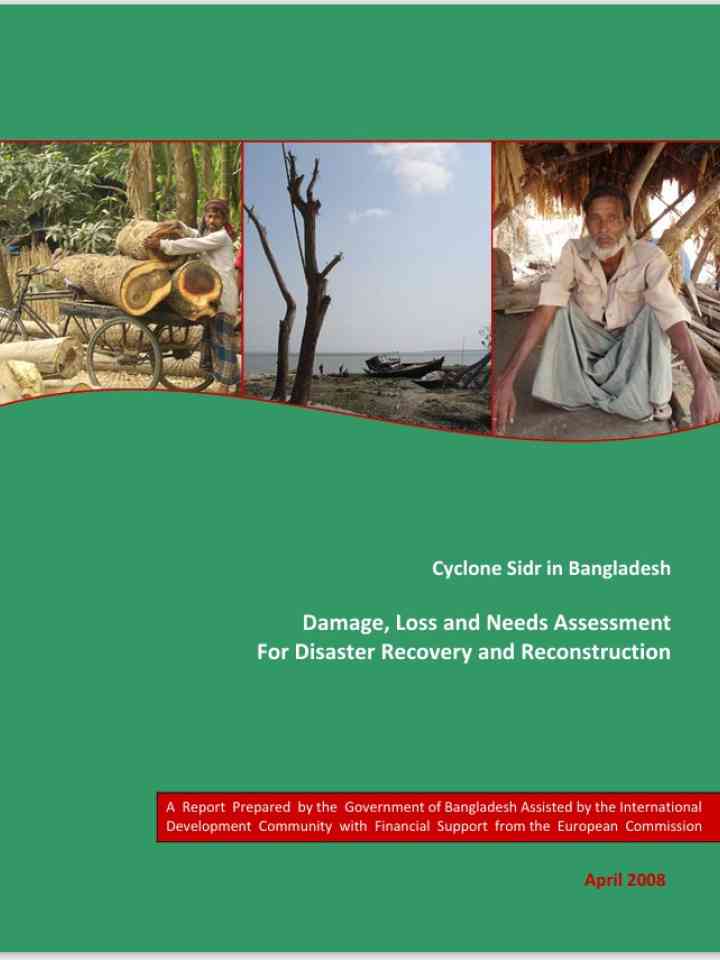
Cyclone Sidr in Bangladesh: Damage, loss, and needs assessment for disaster recovery and reconstruction
Documents and publications
PDNA - Post Disaster Needs Assessments

This document identifies the needs and quantified financial requirements that will facilitate formulating comprehensive early recovery actions, medium‐term recovery and reconstruction plans, and a long‐term risk management and reduction strategy.

Bangladesh - government
World Bank, the
European Commission
International Labour Organization (ILO)
International Federation of Red Cross and Red Crescent Societies (IFRC)
Asian Development Bank (ADB)
United Nations Development Programme (UNDP)
Japan Bank For International Cooperation
Japan International Cooperation Agency
Islamic Development Bank
Food and Agriculture Organization of the United Nations (FAO)
World Food Programme (WFP)
World Health Organization (WHO)
Department for International Development
United States Agency for International Development (USAID)
United Nations Children's Fund (UNICEF)

All PDNAs

Documents and publications
PDNA - Post Disaster Needs Assessments

This report assesses the impact of the 2019 Sindh drought on various sectors and provides recommendations to the Government of Sindh and its partners to prioritize actions to address immediate needs, build back better and increase resilience to drought.  

Food and Agriculture Organization of the United Nations (FAO)
United Nations Children's Fund (UNICEF)
International Organization for Migration (IOM)
National Disaster Management Authority (Pakistan)
Agency for Technical Cooperation and Development (ACTED)
Health and Nutrition Development Society
Documents and publications
PDNA - Post Disaster Needs Assessments

The report formulates recommendations to make Kerala the first green state in India with an eco-sensitive and risk-informed approach. The report also gives several high-ticket innovations and global examples to build back better (BBB) Kerala.

United Nations Development Programme (UNDP)
Global Facility for Disaster Reduction and Recovery, the (GFDRR)
United Nations Development Programme (UNDP)
Post-Disaster Needs Assessment: Gita Cyclone Report Tonga 2018
Documents and publications
PDNA - Post Disaster Needs Assessments

This document uses the post-disaster data collected by the Statistical Department of Tonga to describe the characteristics of the affected population, nature and spatial concentration of the damage by the Cyclone Gita, and the aid required and received.

Tonga - government
United Nations Development Programme (UNDP)
Documents and publications
PDNA - Post Disaster Needs Assessments

This report presents the results of the rapid assessment of the damage caused by Tropical Cyclone Sagar in Djibouti City and the most affected areas, and offers recommendations and a preliminary estimate of recovery and reconstruction needs.

World Bank, the
Global Facility for Disaster Reduction and Recovery, the (GFDRR)
Djibouti - government
Documents and publications
PDNA - Post Disaster Needs Assessments

Tropical Cyclone Gita passed over the Tongatapu and ‘Eua island groups. This post-disaster rapid assessment summarizes damages and losses to several different sectors, human and social impacts, and recovery and reconstruction needs,

Tonga - government
Global Facility for Disaster Reduction and Recovery, the (GFDRR)
Documents and publications
PDNA - Post Disaster Needs Assessments

This report provides a detailed breakdown of the key affected sectors and the extent of damage sustained in the aftermath of Typhoon Damrey. It identifies the reconstruction and recovery needs, and recommends a clear recovery strategy.

World Bank, the
Global Facility for Disaster Reduction and Recovery, the (GFDRR)
Documents and publications
PDNA - Post Disaster Needs Assessments

This PDNA report describes the losses and damage sustained from three disaster events: Tropical Storm Son-Tinh, followed by flash flooding, and Tropical Storm Bebinca. It provides baseline data for recovery planning and monitoring progress.

Global Facility for Disaster Reduction and Recovery, the (GFDRR)
Lao People's Democratic Republic - government
United Nations Development Programme (UNDP)
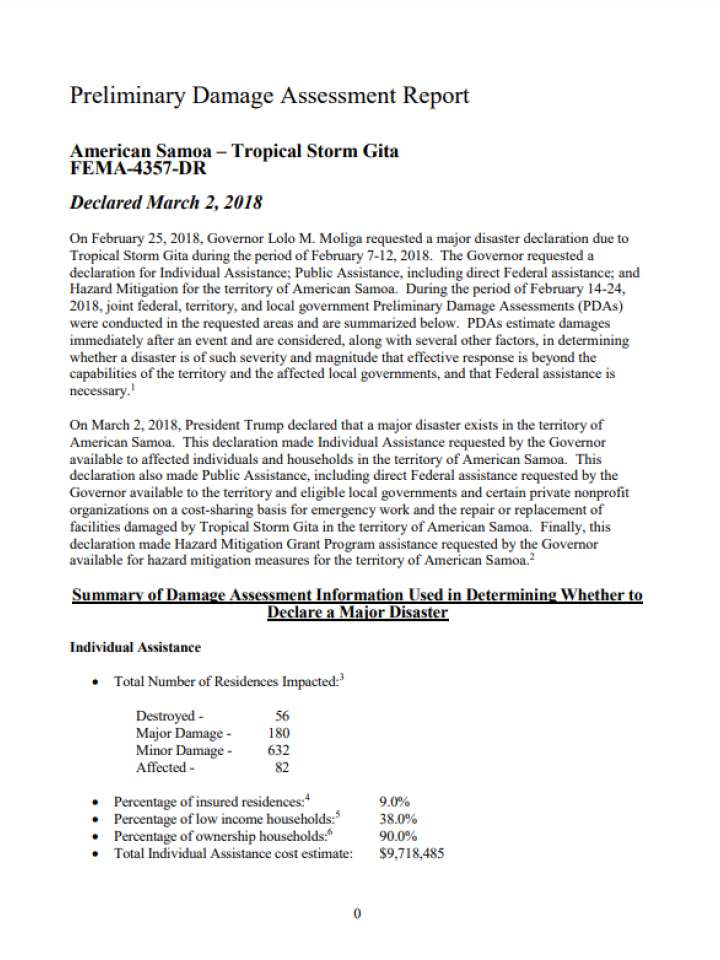
Preliminary Damage Assessment Report  American Samoa – Tropical Storm Gita
Documents and publications
PDNA - Post Disaster Needs Assessments

This document is a summary of the Preliminary Damage Assessments (PDAs) conducted to estimate damages of Tropical Storm Gita in American Samoa.

Federal Emergency Management Agency (FEMA)
Documents and publications
PDNA - Post Disaster Needs Assessments

This drought impact and needs assessment (DINA) was conducted using remote sensing technology to validate findings.

World Bank, the
Global Facility for Disaster Reduction and Recovery, the (GFDRR)
Documents and publications
PDNA - Post Disaster Needs Assessments

The Somalia Drought Impact and Needs Assessment aims to reduce the country’s vulnerability to climate shocks, strengthen resilience and significantly reduce the future risk of famine in Somalia.

World Bank, the
Global Facility for Disaster Reduction and Recovery, the (GFDRR)
Somalia - government

PDNA on-demand training

Meetings and conferences
Brisbane
-
In person
The 2022 Asia-Pacific Ministerial Conference on Disaster Risk Reduction (APMCDRR) presents an opportunity for delegates from across the Asia Pacific to showcase and share experiences, action and innovation to help build a resilient future for the region.
Meetings and conferences
Washington D.C.
Online
peakers will assess the impact of the COVID-19 pandemic on the economies and societies of the Middle East and North Africa, where human development gains have faced a significant setback over the last two years.
Meetings and conferences
-
In person
WCS 2022 seeks to address this with its theme of Liveable and Sustainable Cities: Emerging Stronger.
Meetings and conferences
Online
The Eighth LAS-Japan-UNDP Policy Roundtable will explore the emerging disaster risks from climate change to the Arab region and identify means and best practices for building resilience to climate disasters.
Training event
Cartagena
Online
This High-Level Seminar Water and post-COVID recovery will be a space for dialogue to better understand and analyze the situation of water management after changes produced by COVID-19 and to reflect on the needs and the measures to adopt in the future.
Meetings and conferences
New York
-
In person
The theme for the HLPF 2022 will be “Building back better from the coronavirus disease (COVID-19) while advancing the full implementation of the 2030 Agenda for Sustainable Development”.
Meetings and conferences
Online
This event will highlight the importance of infrastructure asset management and how it can help countries get back on track to meet the SDGs and accelerate recovery.