PreventionWeb
Menu

International Journal of Disaster Risk Reduction (Elsevier)

IJDRR

Mission

The International Journal of Disaster Risk Reduction (IJDRR) is the journal for researchers, policymakers and practitioners across diverse disciplines: earth sciences and their implications; environmental sciences; engineering; urban studies; geography; and the social sciences. IJDRR publishes fundamental and applied research, critical reviews, policy papers and case studies with a particular focus on multi-disciplinary research that aims to reduce the impact of natural, technological, social and intentional disasters. IJDRR stimulates exchange of ideas and knowledge transfer on disaster research, mitigation, adaptation, prevention and risk reduction at all geographical scales: local, national and international.
Show more
Latest additions
Items: 46
Publication
Published on
11 August 2025
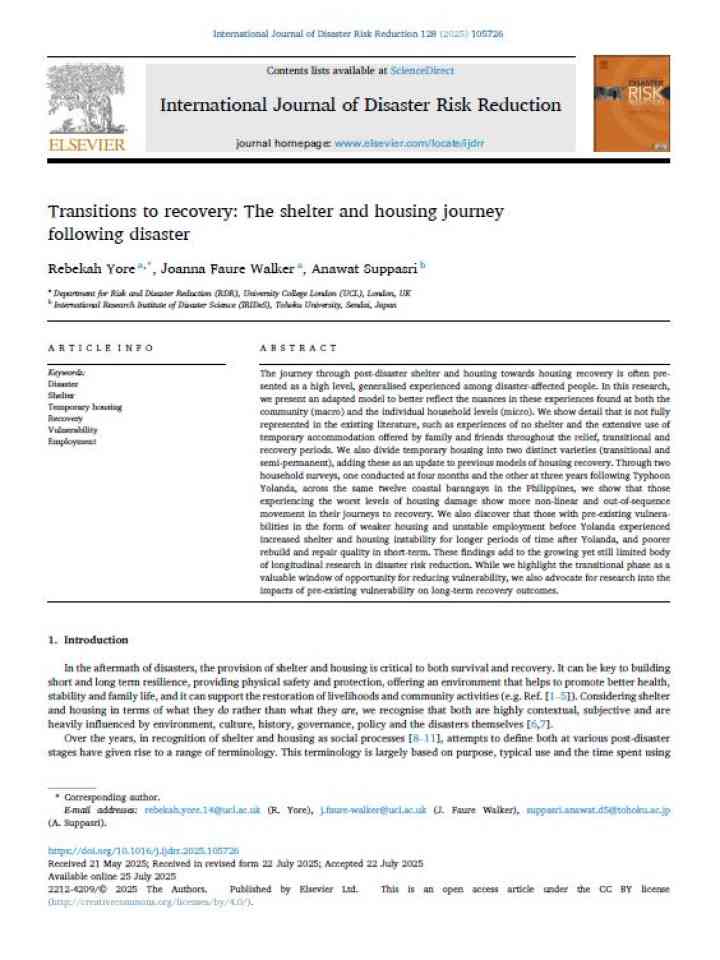
Transitions to recovery: The shelter and housing journey following disaster
In this research, the authors present an adapted model to better reflect the nuances in these experiences found at both the community (macro) and the individual household levels (micro) with regards to post-disaster shelter and housing.
Publication
Published on
21 March 2025
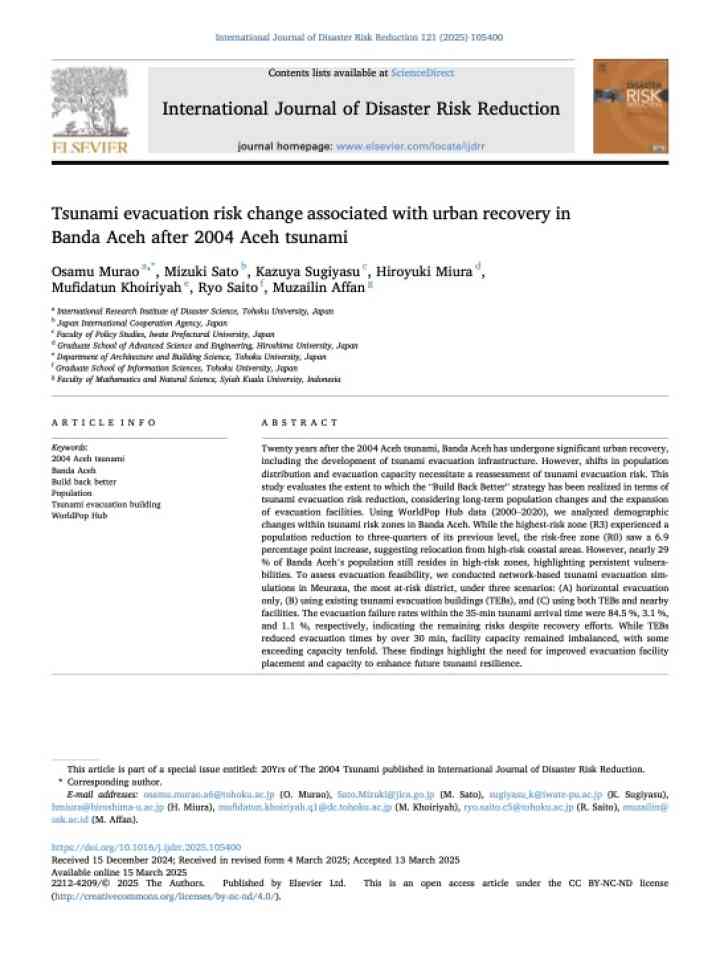
Tsunami evacuation risk change associated with urban recovery in Banda Aceh after 2004 Aceh tsunami
This study analyzes changes in tsunami evacuation risk in Banda Aceh post-2004. While TEBs improved safety, population shifts and infrastructure limits leave 29% at risk.
Publication
Published on
12 February 2025
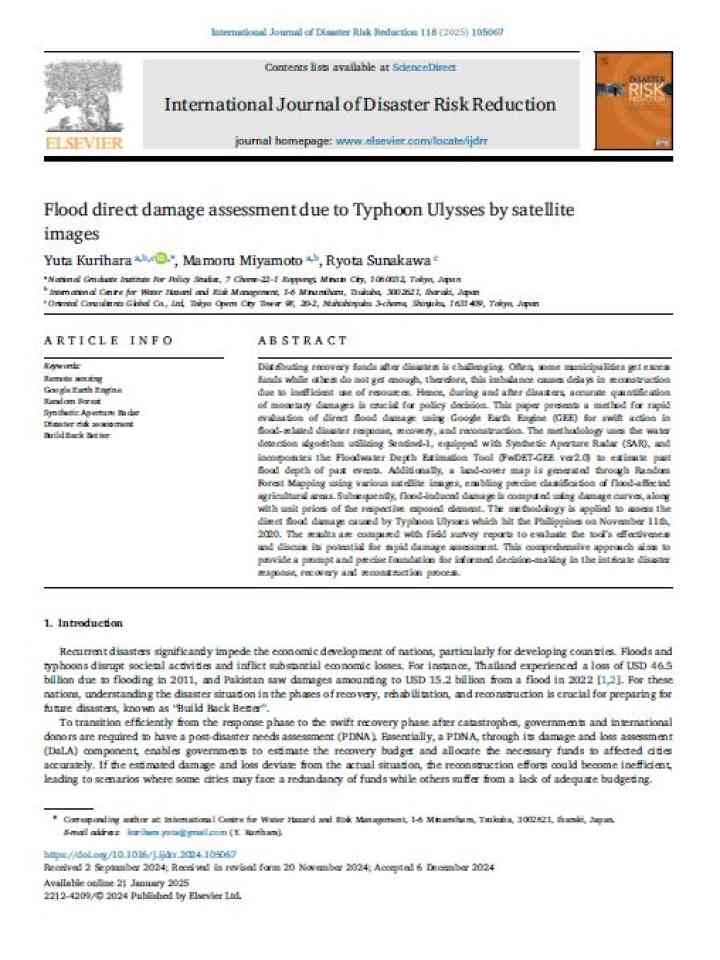
Flood direct damage assessment due to Typhoon Ulysses by satellite images
This paper presents a method for rapid evaluation of direct flood damage using Google Earth Engine (GEE) for swift action in flood-related disaster response, recovery, and reconstruction.
Publication
Published on
29 October 2024
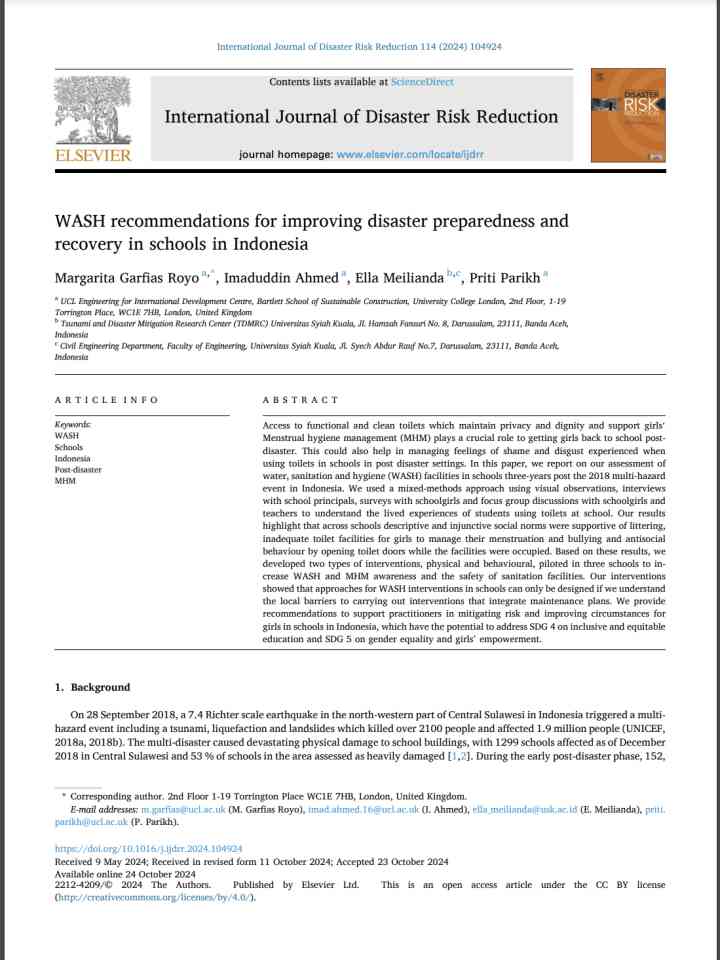
WASH recommendations for improving disaster preparedness and recovery in schools in Indonesia
This paper reports on the recommendations that arose from the mixed-methods exploration and pilot interventions carried out for the resilient recovery around water, sanitation and hygiene of schools three years post-disaster.
Publication
Published on
23 October 2024
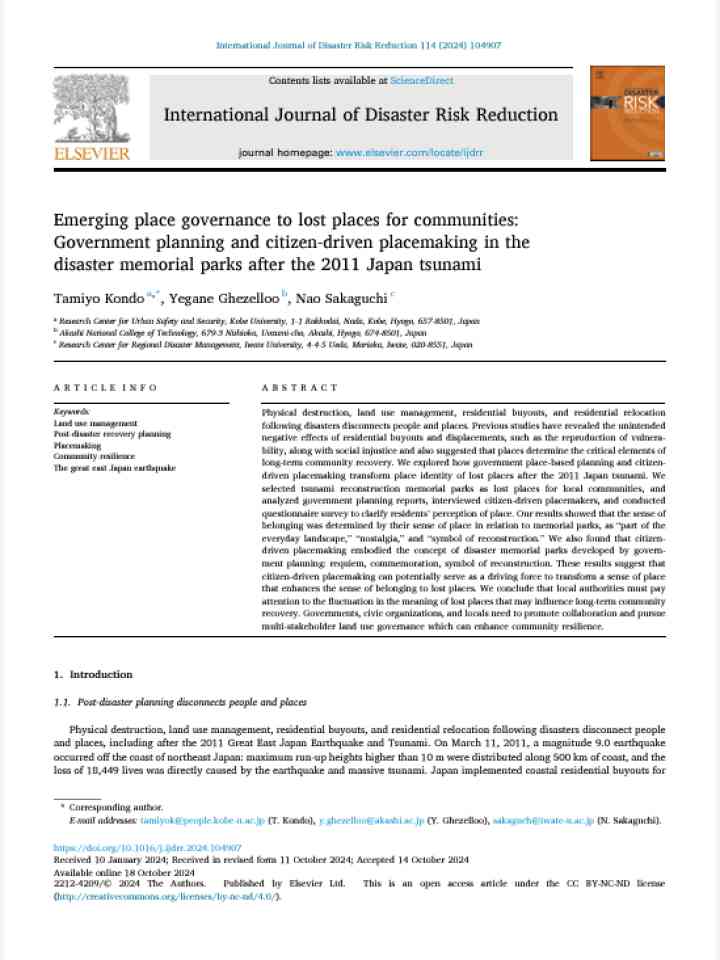
Emerging place governance to lost places for communities: Government planning and citizen-driven placemaking in the disaster memorial parks after the 2011 Japan tsunami
This study explored how government place-based planning and citizen-driven placemaking transform place identity of lost places after the 2011 Japan tsunami.
Publication
Published on
1 May 2024
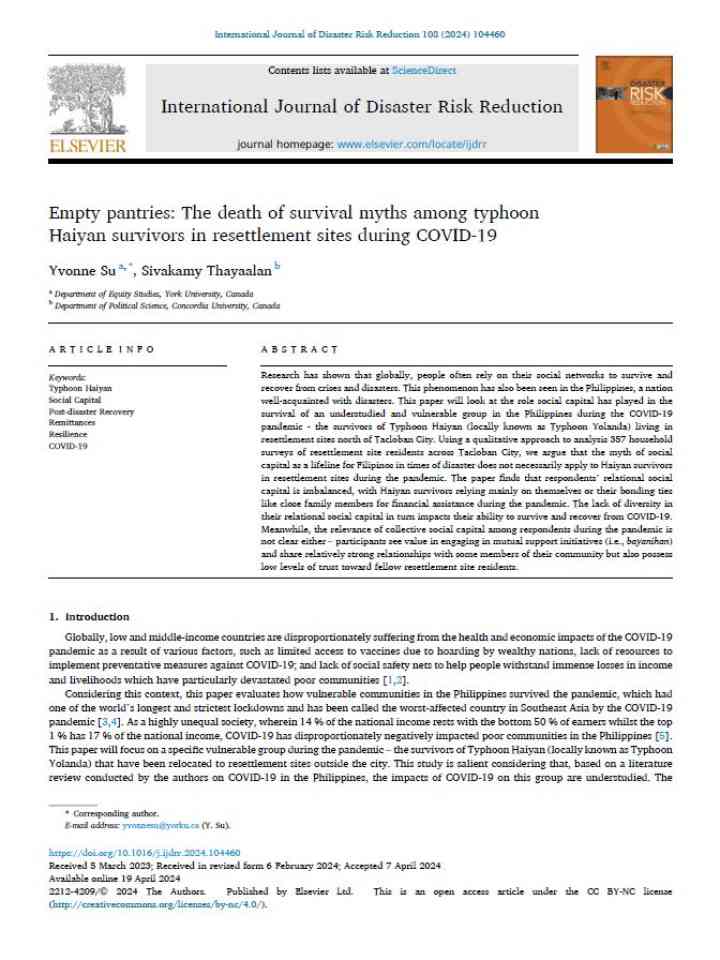
Empty pantries: The death of survival myths among typhoon Haiyan survivors in resettlement sites during COVID-19
This paper looks at the role social capital has played in the survival of an understudied and vulnerable group in the Philippines during the COVID-19 pandemic - the survivors of Typhoon Haiyan (locally known as Typhoon Yolanda).
Publication
Published on
22 March 2024
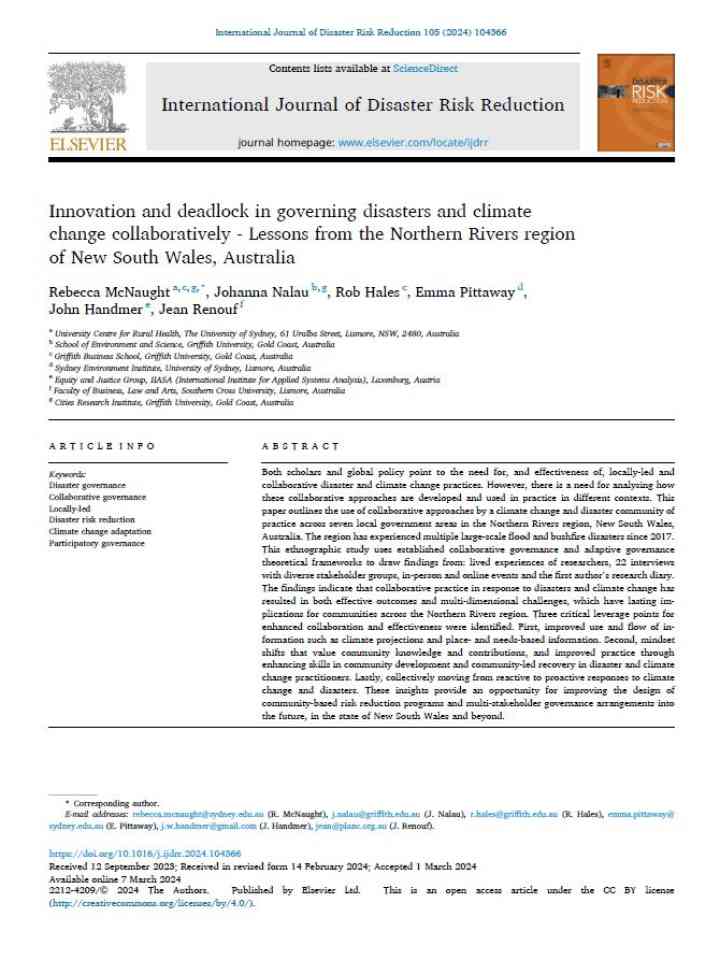
Innovation and deadlock in governing disasters and climate change collaboratively - Lessons from the Northern Rivers region of New South Wales, Australia
This paper outlines the use of collaborative approaches by a climate change and disaster community of practice across seven local government areas in the Northern Rivers region, New South Wales, Australia.
Publication
Published on
15 October 2023
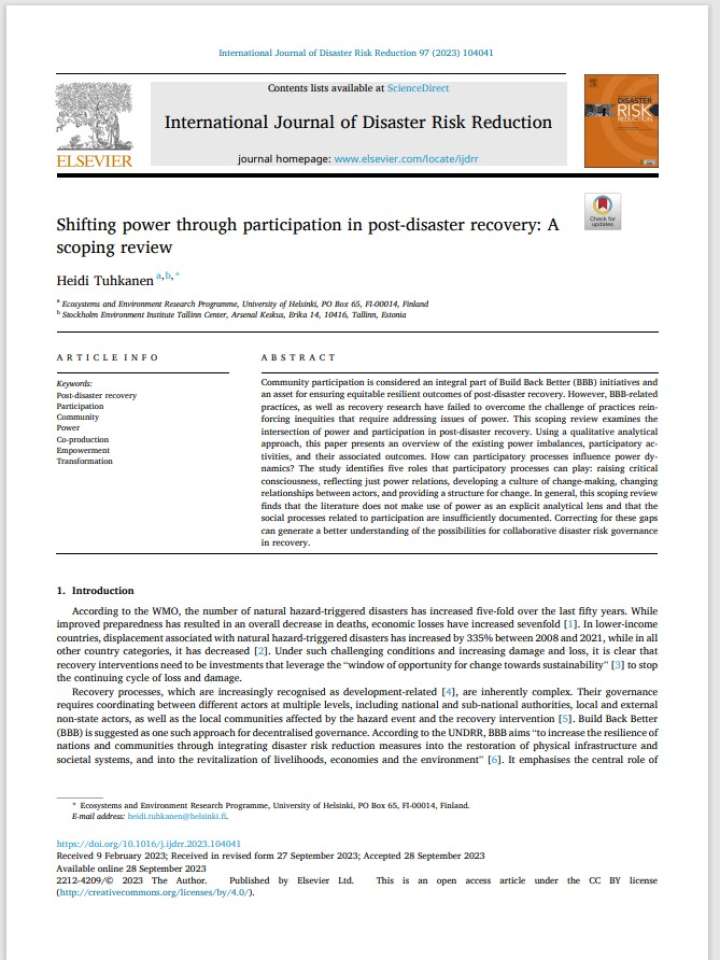
Shifting power through participation in post-disaster recovery: A scoping review
This scoping review examines the intersection of power and participation in post-disaster recovery.

Pagination

  • Previous page ‹ Previous
  • Page 1
  • Current page 2
  • Page 3
  • Page 4
  • Page 5
  • Page 6
  • Next page Next ›

More content for this organization may be available on PreventionWeb or on the site search.

Voluntary Commitments

The organization has no registered commitments.

The Sendai Framework Voluntary Commitments (SFVC) online platform allows stakeholders to inform the public about their work on DRR. The SFVC online platform is a useful toolto know who is doing what and where for the implementation of the Sendai Framework, which could foster potential collaboration among stakeholders. All stakeholders (private sector, civil society organizations, academia, media, local governments, etc.) working on DRR can submit their commitments and report on their progress and deliverables.

Contact information

https://www.journals.elsevier.com/international-journal-of-disaster-risk-reduct…

Is this page useful?

Yes No
Report an issue on this page

Thank you. If you have 2 minutes, we would benefit from additional feedback (link opens in a new window).

The International Recovery Platform (IRP) is a global partnership working to strengthen knowledge, and share experiences and lessons on building back better in recovery, rehabilitation, and reconstruction.

Latest IRP videos and photos: YouTube Flickr Contact IRP

Loading