PreventionWeb
Menu
PDNA - Post Disaster Needs Assessments

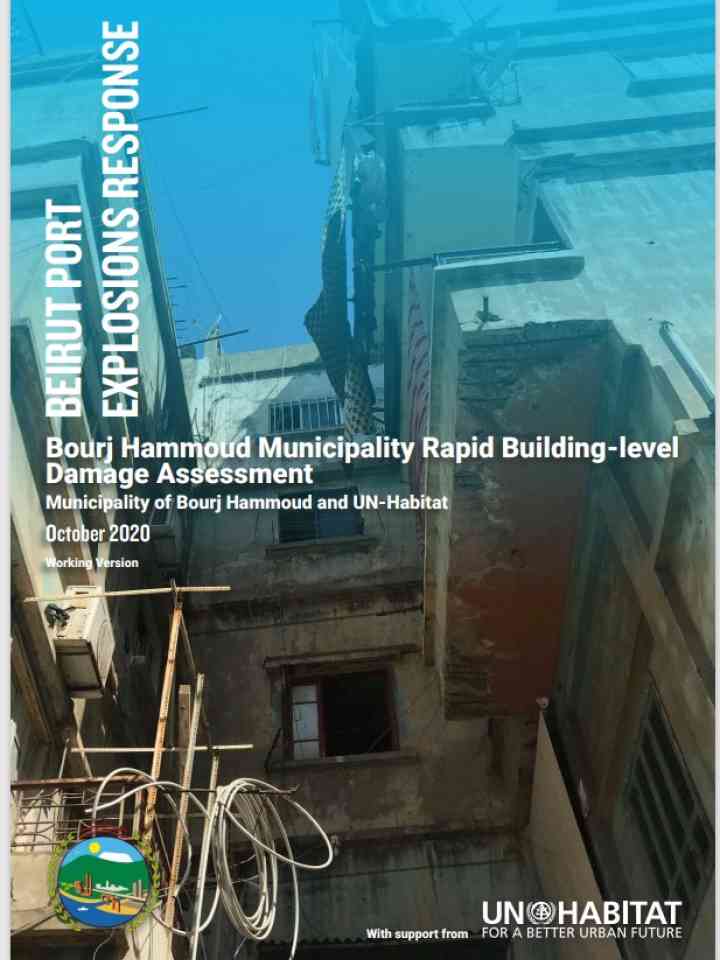
Beirut Port Explosions Response – Bourj Hammoud Municipality Rapid Building-Level Damage Assessment

Source
United Nations Human Settlements Programme (UN-HABITAT)

The Port of Beirut explosions (4 August 2020) resulted in extensive damage on multiple levels – the loss of life, injury and the destruction of vast tracts of urban fabric within the municipal boundaries of Beirut and Bourj Hammoud. In support of the Municipality of Bourj Hammoud, UN-Habitat together with the Polish Center for International Aid, Naba’a and Beirut Arab University, undertook a rapid damage assessment at the building level (exterior visual survey).

The assessment covered all building types, dividing them into four categories (unsafe/evacuate, restricted use, safe/minor damage and not affected) in order to understand the extent of damage, particularly structural impacts, as well as immediately identifying buildings at risk of collapse and in need of evacuation. The assessment provides a basis on which to formulate recovery and reconstruction measures with regards to building damage rehabilitation.

Download

Beirut Port Explosions Response – Bourj Hammoud Municipality Rapid Building-Level Damage Assessment PDF, 2.6 MB English

Last checked: 15 April 2024

Editors' recommendations

  • Beirut Rapid Damage and Needs Assessment
  • Lebanon Reform Recovery and Reconstruction Framework (3RF)
  • Beirut Port Explosions Response - Beirut Municipality Rapid Building-Level Damage Assessment

Explore further

Hazards Technological hazard
Themes Disaster losses Recovery
Country and region Lebanon
Beirut Port Explosions Response – Bourj Hammoud Municipality Rapid Building-Level Damage Assessment
Number of pages
12 p.
Publication year
2020

Is this page useful?

Yes No
Report an issue on this page

Thank you. If you have 2 minutes, we would benefit from additional feedback (link opens in a new window).

The International Recovery Platform (IRP) is a global partnership working to strengthen knowledge, and share experiences and lessons on building back better in recovery, rehabilitation, and reconstruction.

Latest IRP videos and photos: YouTube Flickr Contact IRP

Loading