PreventionWeb
Menu
Author(s) Anil K Gupta Shashikant Chopde Sreeja S. Nair et al.

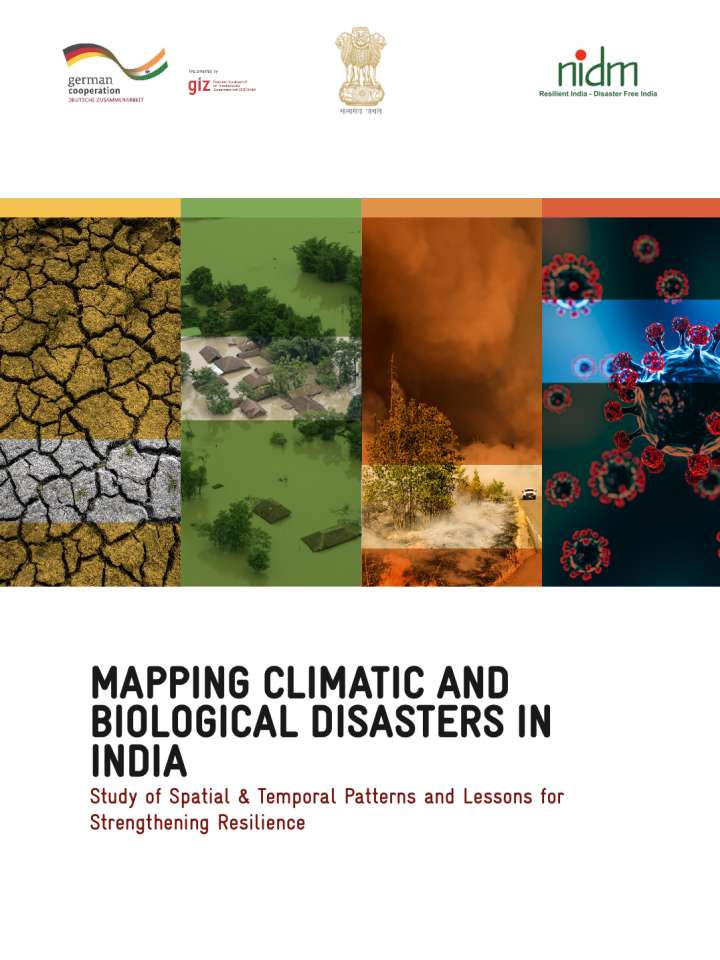
Mapping climatic and biological disasters in India: Study of spatial and temporal patterns and lessons for strengthening resilience

Source
Federal Ministry for Economic Cooperation and Development
Deutsche Gesellschaft für Internationale Zusammenarbeit (GIZ)
National Institute of Disaster Management (India)

Spatio-temporal mapping of climatic and biological disaster outbreak in India has been undertaken using historical data and scientific tools to explore options to support for relief, recovery, resilience, and adaptation through integration with existing development programmes. Floods, Droughts, Cyclones, Heat Waves and Cold Waves, Dengue, JE and COVID-19 have been considered, given their widespread occurrences and impacts in India. In addition, multi-hazard assessments are carried out for combined climatic, combined biological and combined climatic and biological disasters. In this report, data is compiled from hand-scanned government documents, international reports on disaster and disease outbreaks and scientific literature analysis. Three time-periods have been selected: pre-HFA (1995-2005), HFA (2005- 2015) and post-HFA (i.e., Sendai period 2015-2030).

The study comes up with a number of valuable lessons and recommendations for strengthening disaster reduction system and resilience in India through interventions related to policy, institutional, programmatic/ schemes and financial allocations. The study presents key findings and lessons that have a bearing on overall implementation of disaster management system in India vis-à-vis changing risk patterns due to progress/changes in development, urbanisation and environmental health over the last 25 years (91995-2020).

Download

Access Mapping climatic and biological disasters in India: Study of spatial and temporal patterns and lessons for strengthening resilience
Download a backup copy hosted by this site PDF, 3.5 MB English

We keep a copy of many documents to improve long-term access. Use this if the publisher’s site is slow or unavailable. Problems? Contact us.

Last checked: 2 February 2022

Editors' recommendations

  • The costs of climate change in India: a review of the climate-related risks facing India, and their economic and social costs
  • G20 Climate Risk Atlas: India
  • Physical climate risk and vulnerability assessment: India Analysis
  • Disaster risk reduction in India: Status report 2020
  • Hot, wet, and deserted: Climate change and internal displacement in India, Peru, and Tanzania
  • Creating urban water resilience in India: A water balance study of Chennai, Bengaluru, Coimbatore, and Delhi

Explore further

Hazards Cold Wave Cyclone, Hurricane and Typhoon Drought and Desertification Flood Heatwave and Extreme Heat
Themes Climate change Environment and ecosystems GIS and mapping Recovery Social impacts and social resilience
Country and region India
This image shows the first page of the publication.
ISBN/ISSN/DOI
978-81-955009-1-8 (ISBN)
Number of pages
145 p.
Publication year
2021

Also featured on

PreventionWeb

Is this page useful?

Yes No
Report an issue on this page

Thank you. If you have 2 minutes, we would benefit from additional feedback (link opens in a new window).

The International Recovery Platform (IRP) is a global partnership working to strengthen knowledge, and share experiences and lessons on building back better in recovery, rehabilitation, and reconstruction.

Latest IRP videos and photos: YouTube Flickr Contact IRP

Loading