This study builds on natural hazards behavior, community development, participatory, and codesign research to understand current community engagement approaches in an Australian context.
The normative dimensions of flood harm in flood risk management (FRM) have become salient in a milieu of extreme flood events. In this article, two types of flood harm will be discussed. They are namely, risk harm and outcome harm.
The objective of this document is to present a step-by-step framework to support countries to design and assess green recovery and green economy options that build on NDC processes and incorporate climate action.
The primary objective of this tool is to guide Disaster Risk Reduction (DRR) and civil protection professionals to the practical information they need to ensure that their work is fully inclusive.
The ASEAN-UN Joint Strategic Plan of Action on Disaster Management (JSAPDM) IV 2021-2025 outlines ASEAN and the UN’s mutual intentions and commitments to continue to work together, guided by the strategies and priorities incorporated by ASEAN into the AADMER Work Programme (2021-2025), as well as other global priorities in humanitarian action. The JSPADM IV (2021-2025) also takes into account the implementation results of the JSPADM III (2016-2020) and its chartered priority areas for collaboration in support of the AADMER Work Programme (20162020).
This update assesses the impacts of the Hunga Tonga–Hunga Haʻapai volcanic eruption and tsunami on agriculture, livelihoods, and food security in Tonga, using geospatial and sectoral analysis to inform response and recovery.
Food and Agriculture Organization of the United Nations (FAO)
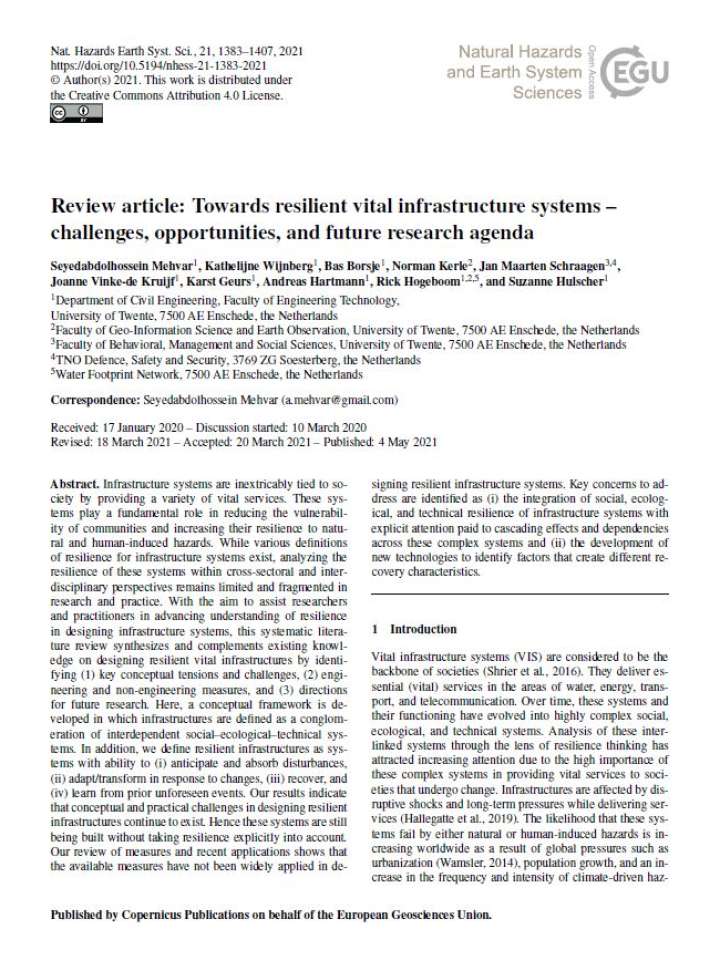
With the aim to assist researchers and practitioners in advancing understanding of resilience in designing infrastructure systems, this systematic literature review synthesizes and complements existing knowledge on designing resilient vital infrastructure
This study aims to test a methodology for teaching people about the characteristics of each post-disaster phase concerning road infrastructure and business continuity.
This document is intended to guide local authorities and First Nations as they plan for postdisaster recovery. It is scalable and can be used from a small event (e.g. single apartment fire) to a large event (e.g. wildfire event).