This guidance is to help the target audience ensure that all members of the community affected by disasters do not face unlawful discrimination on the basis of race, color, or national origin in violation of Title VI of the Civil Rights Act of 1964
This Standard Operating Procedure (SOP) guides the State and its agencies in undertaking a post-disaster needs assessment (PDNA) and in developing a recovery and reconstruction plan of actions to build back better
The “Model Act for the Facilitation and Regulation of International Disaster Relief and Initial Recovery Assistance” is intended to assist states to strengthen their legal preparedness for international disaster cooperation. It is built upon, and is
International Federation of Red Cross and Red Crescent Societies (IFRC)
This paper analyses the causes, impacts, and governance gaps revealed by the 2018 Kerala floods, emphasizing disaster risk reduction, climate change, and the need for resilient recovery planning.
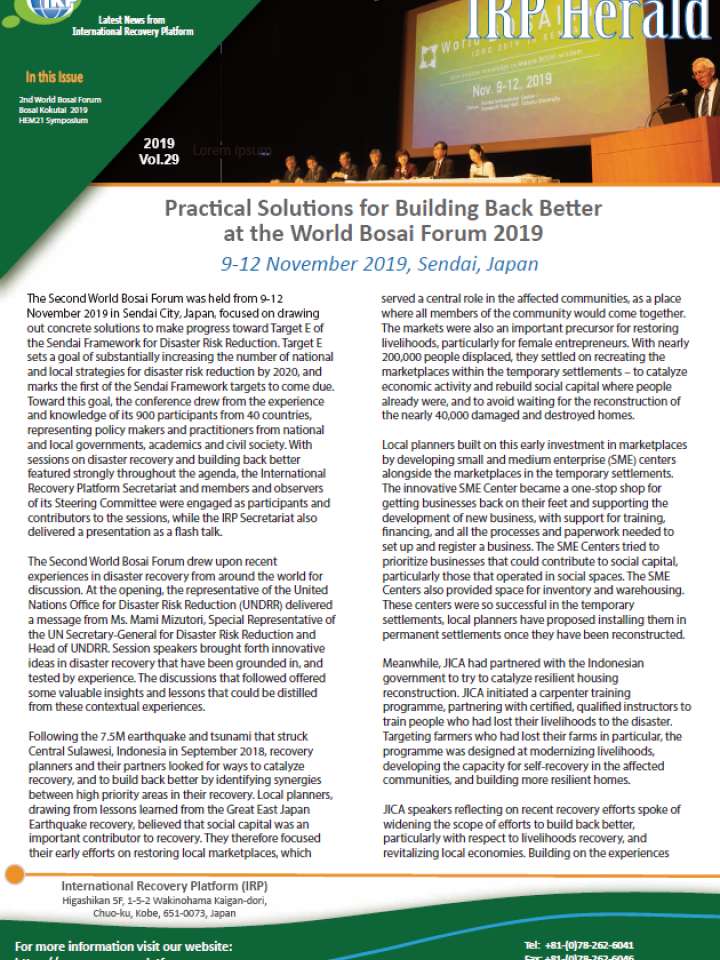
IRP Herald Volume 29 serves as the knowledge report for the World Bosai Forum 2019, the Fourth National Conference on Promoting Disaster Risk Reduction (Japan), and the Hyogo Earthquake Memorial Symposium.
This paper highlights how governments and other actors can prepare for the governance challenges of disaster response, recovery, and reconstruction. It identifies two sets of enabling factors need to be in place before disaster events occur to help avoid
The State of Connecticut Disaster Recovery Framework (DRF) provides a framework for state‐level support of local and tribal recovery efforts through partnerships with local, state, tribal, non‐governmental and federal organizations.
The the RDPO developed a Regional Recovery Framework takes an all-hazards approach and outlines how to establish resilient and equitable local and regional recovery operations.
Regional Disaster Preparedness Organization (Oregon, USA)