This report describes the 20 best practices distilled from a recent Real Time Evaluation of EARLI, a cash for work program implemented by CRS in Niger. EARLI is a USAID/OFDA-funded food security and land recuperation project in which vulnerable households
This book provides a critical perspective on people’s response to disasters in the Philippines. It shows that disasters are neither natural nor the fault of vulnerable and helpless people. It asserts that those who suffer from disasters are made
This document presents the key lessons learned from a team of experts reassembled to evaluate Japan’s long-term efforts to recover from the Great Eastern Japan Earthquake and to prepare for future catastrophes. Based on extensive literature and interviews with Japanese officials and experts, it identifies four critical areas that affect response to a catastrophe: (i) recovery and resiliency of critical infrastructure, (ii) environmental remediation, (iii) compensation and disaster assistance, and (iv) population resiliency. In each area, it makes key observations, determines findings, and develops recommendations for learning from Japan’s experience.
This issue presents articles covering different aspects of microinsurance within the disaster risk reduction (DRR) context. The articles, contributed by experts and practitioners from DRR and insurance
This document deals with the ethical principles of the whole disaster cycle: from prevention to reconstruction via the emergency phase, irrespective of the duration of the disaster (sudden or progressive) or its context (simple or complex emergency). It
Council of Europe (COE)
European and Mediterranean Major Hazards Agreement
Using as an example the 4 May 2007 tornado that levelling 95 per cent of the town of Greensburg, Kansas, and killing eleven of its fourteen hundred residents, this essay addresses the balance between the need
This study focuses on the 2006 landslide tragedy in the Philippines, where an entire community, including its people, its productive assets, and its socio-cultural resources, was totally buried. It reports on the various levels of recovery that have been achieved among the provision of community services and facilities such as health, education, recreation, infrastructure, livelihood opportunities and psychosocial services; and identifies the limitations of the principle of "build back better" as well as those areas of concern in which the principle can best be applied.
This special issue of the quarterly ERRA newsletter focuses on the major earthquake that struck northern Pakistan on October 8, 2005. It describes the response to the disaster, followed by the establishment of the Earthquake Reconstruction and
Earthquake Reconstruction and Rehabilitation Authority
Community adaptation and risk reduction governance series, issue 2, December 2011:
This edition considers gender issues after disaster in Nias Island, North Sumatra, Indonesia, such as the Indian Ocean tsunami on 24 December 2004 and the 28 March 2005
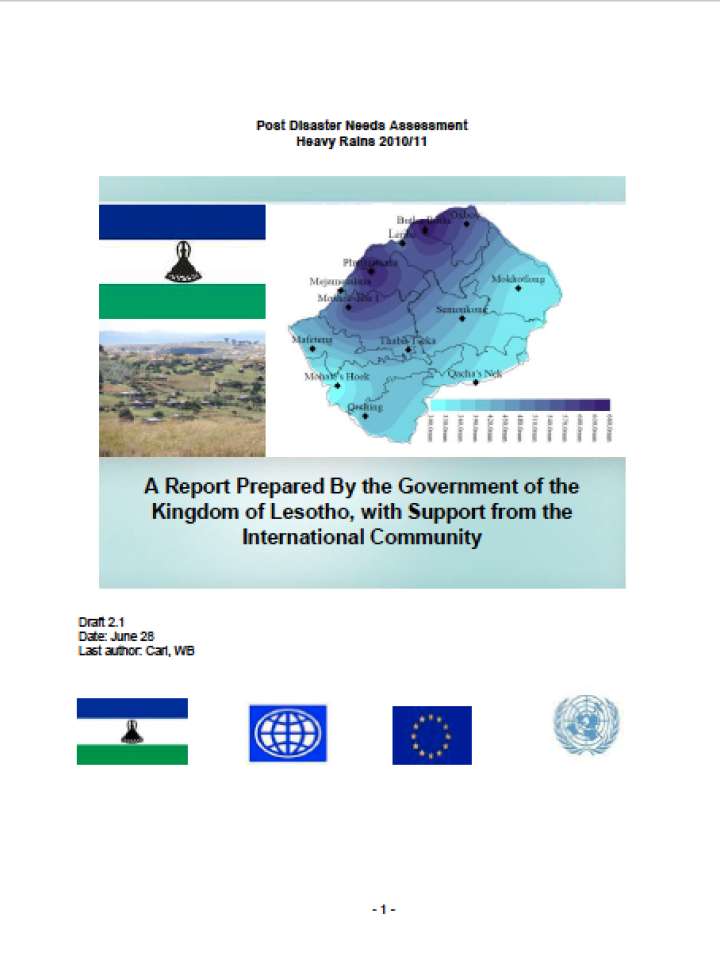
This PDNA examines the social and economic damage caused by a series of extreme weather events between December 2010 and February 2011 in Lesotho. A disaster recovery framework with guiding principles for reconstruction and DRR programs is included.
Lesotho - government
United Nations Development Programme (UNDP)
Global Facility for Disaster Reduction and Recovery, the (GFDRR)