This case study looks at the gender dimensions of two projects supported by the Asian Development Bank (ADB) in Sri Lanka: the North East Coastal Community Development Project (NECCDP) and Component B of the Tsunami-Affected Areas Rebuilding Project.
This last use case from the Global Agenda Council on Risk and Resilience highlights tangible examples from Nepal of where multi-stakeholder partnerships between the public and private sectors and civil society organisations made a difference, and where they could be scaled up to be more effective in future.
Drought-affected communities in 3 Papua New Guinea provinces were assessed in Sept-Oct 2015, alongside a rapid gender analysis. This report summarizes needs, capacities, and findings on food security, WASH, livelihoods, health, coping, and recovery.
This final report presents the outcomes of the Making Cities Resilient New Orleans-Gothenburg exchange. The exchange was part of the United Nation's Making Cities Resilient campaign and concerned with disaster resilience with particular focus on high
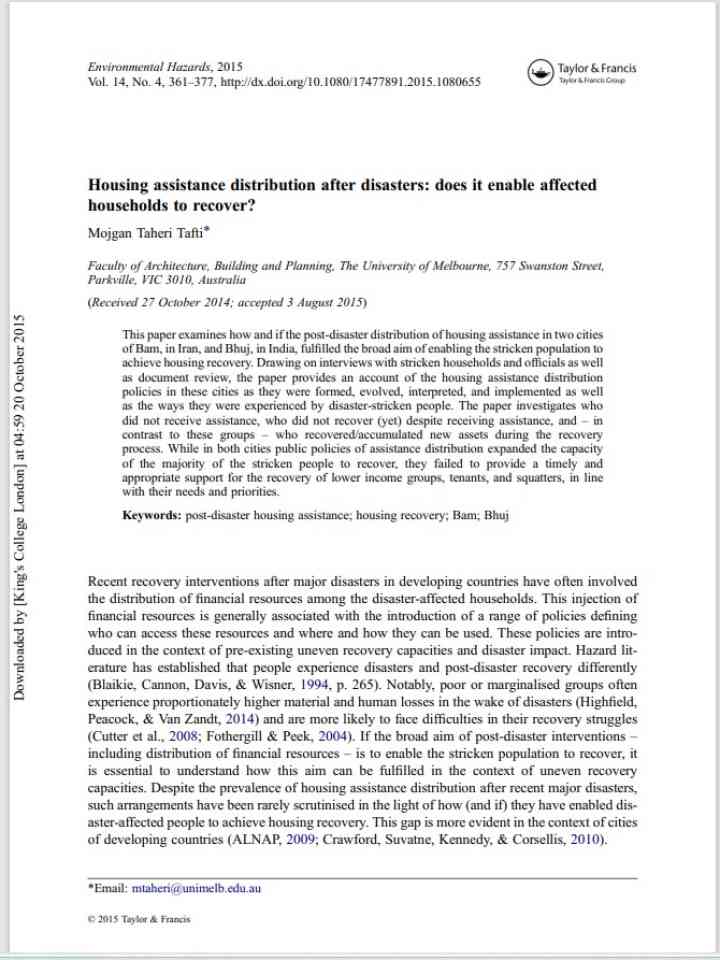
This paper examines how and if the post-disaster distribution of housing assistance in two cities of Bam, in Iran, and Bhuj, in India, fulfilled the broad aim of enabling the stricken population to achieve housing recovery.
PLoS ONE 10(10): e0138714. doi:10.1371/journal.pone.0138714:
This paper presents the quantification of the "permanent" socio-economic impacts of the Great Hanshin-Awaji (Kobe) earthquake in 1995 by employing a large-scale panel dataset of 1,719 cities
This short document draws on development good practice and experience, both from Myanmar as well as internationally, to share ways in which the private sector can use its investments to strengthen recovery activities.
This year's study compiles the latest statistics on the size and scope of the humanitarian system and assesses overall performance and progress in the period 2012-2014. The humanitarian system’s performance is assessed within its core functions of
Active Learning Network for Accountability and Performance (ALNAP)
This report presents good practices in the promotion of economic empowerment of women in the post-disaster situations through entrepreneurship development in Japan and the Asia Pacific region.
This report focuses on the first five months after the Nepal Earthquakes of 2015 and reviews the current legal and institutional framework for disaster risk management in Nepal and highlights its gaps and limitations in the context of the recent disaster.