Each year, the United Nations Children’s Fund (UNICEF) responds to more than 200 emergencies around the world, working with governments, civil society, communities, private companies and non-governmental organizations to meet urgent needs, protect
This document reports on achievements in many critical areas including child protection, education, health, livelihoods and disaster risk reduction by Save the Children as a result of their planned five-year response and recovery program in five countries
This paper summarizes the state of the economic literature examining the aggregate impact of disasters. The paper reviews the main disaster data sources available, discusses the determinants of the direct effects
This handbook offers a menu of best practice tools for preventing and detecting corruption in humanitarian operations that includes ways to track resources, confront extortion and detect aid diversion.
This document reviews how Nicaragua has recovered from Hurricane Mitch over the past ten years. The focus is on how relevant the assumptions and claims that were made in the initial recovery planning have been in light of subsequent development.
Stockholm Environment Institute
ProVention Consortium
Glemminge Development Research AB
Institute of Applied Research and Local Development
This book describes innovative findings of integrated river basin management with specific emphasis on flood risk reduction. It also presents the method and application of the participatory GIS and remote sensing for disaster risk assessment, which is one
This publication has been created with the intention of capturing key characteristics of the response and lessons learned, in a widely available format. It is intended to provide a valuable reference in future disaster responses.
The content is based on the DEC Assurance Mission (Arup, 2007) as well as the authors observations and experiences on previous assignments in Aceh during the post-tsunami response. This is supported by further research and consultation, additional information provided by DEC Member Agencies and other documentation of the response. The views expressed are those of the authors.
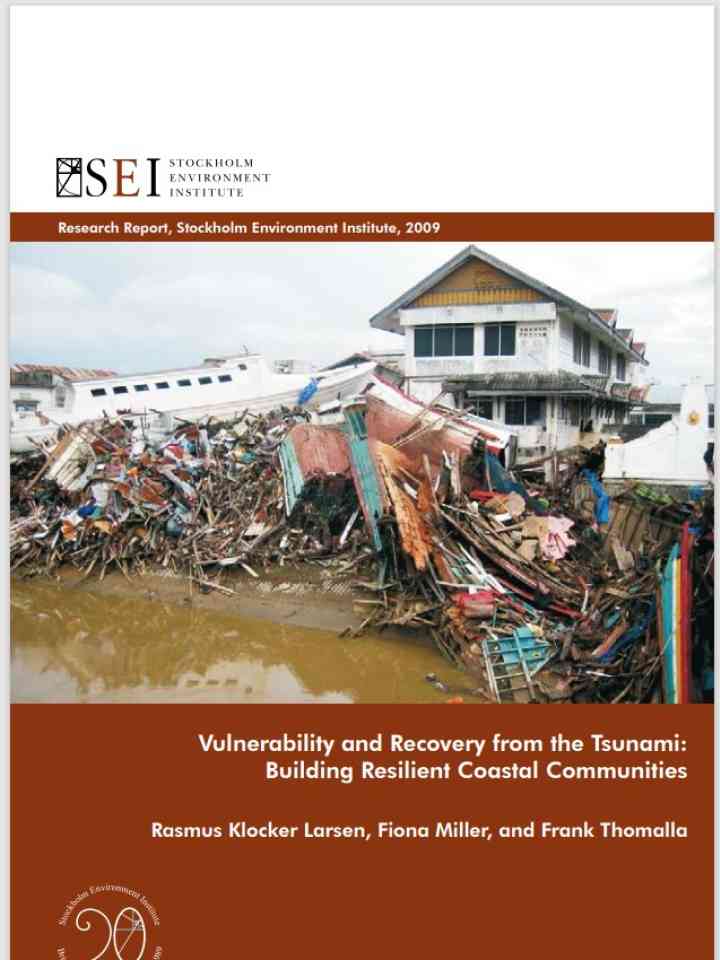
This report provides a meta-analysis to synthesise insights from the tsunami recovery literature on the key factors contributing to vulnerability to the 2004 Indian Ocean Tsunami and to emerging vulnerabilities related to post-disaster recovery.
This manual aims to provide support tools regarding procedures, functions and interrelation among the Micro-regional Crisis Recovery Units (UMACs). UMACs' goal is to increase local capacities to re-establish public services and food production immediately
This handbook was developed to assist policy makers and project managers engaged principally in large-scale post-disaster reconstruction programs make decisions about how to reconstruct housing and communities.
World Bank, the
Global Facility for Disaster Reduction and Recovery, the (GFDRR)