This study documents IFRC’s response and recovery operation in the aftermath of the 2004 Indian Ocean tsunami. Over 4.8 million people benefited from a wide range of Red Cross Red Crescent support that included reconstruction of physical infrastructure such as homes, schools and health facilities as well as long-term recovery and disaster risk reduction programming. It reflects the scale of what is recorded as the deadliest tsunami in history – one that swept through coastal areas of Indonesia, Sri Lanka, the Maldives, Thailand, and ten other Indian Ocean countries.
International Federation of Red Cross and Red Crescent Societies (IFRC)
The preparation of this National Progress Report has been undertaken within the framework of the biennial 2011-13 HFA Monitoring and Progress Review process, facilitated by UNISDR and ISDR System partners.
The preparation of this National Progress Report has been undertaken within the framework of the biennial 2011-13 HFA Monitoring and Progress Review process, facilitated by UNISDR and ISDR System partners.
The preparation of this National Progress Report has been undertaken within the framework of the biennial 2011-13 HFA Monitoring and Progress Review process, facilitated by UNISDR and ISDR System partners.
This document includes a set of 32 notes grouped into six thematic clusters: (i) structural measures; (ii) non-structural measures; (iii) emergency response; (iv) reconstruction planning; (v) hazard and risk information and decision making; and (vi) economics of disaster risk, risk management, and risk financing.
World Bank, the
Japan - government
Global Facility for Disaster Reduction and Recovery, the (GFDRR)
This issue presents articles covering different aspects of community-managed approach in disaster risk reduction context. Practitioners have shared learning from project implementation with disaster affected
This research report is concerned with the purpose of disseminating experience and lessons learned from the East Japan Earthquake and Tsunami (EJET) to help strengthen disaster resilience of disaster prone regions in Japan and the world. It focuses on different aspects of disaster risk reduction (DRR) and environmental management.
Graduate School of Global Environmental Studies, Kyoto University 地球環境学堂・地球環境学舎・三才学林
This knowledge note addresses the transition between emergency FM to community FM radios in Japan following the devastation brought by the March 11, 2011 Great East Japan Earthquake, which destroyed the regional disaster prevention emergency communication. It explains that temporary emergency FM stations broadcasted detailed local information so that tsunami advisory and warning could reach the residents, but that they had to become community FM in order to continue broadcast after their operational expiration date.
Graduate School of Global Environmental Studies, Kyoto University 地球環境学堂・地球環境学舎・三才学林
This book is intended to provide an overview of the concept of ecosystem approach to disaster risk reduction (Eco-DRR), natural resource management and disaster linkages, incorporating Eco-DRR concepts in various phases of disaster management, including post disaster recovery in wide range of human and natural environmental settings.
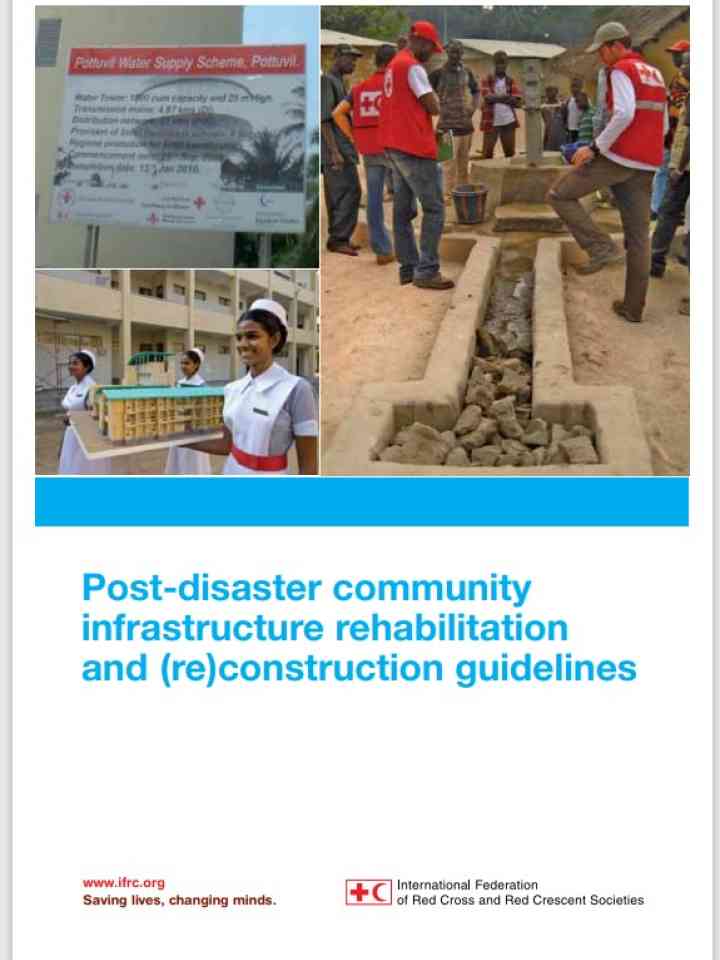
The aim of these guidelines is to promote a change in the approach to community infrastructure, informed by emerging practices, capitalizing on the experiences and expertise in response to the 2004 Indian Ocean tsunami, and other recent events.
International Federation of Red Cross and Red Crescent Societies (IFRC)