This paper presents German views on disaster risk management for sustainable development. It contains a section on linking theory and practice, which covers risk analysis, disaster preparedness, disaster prevention and mitigation, and aid and
Federal Ministry for Economic Cooperation and Development
This report presents the consequences, one month after, of the "Great Eastern Japan Earthquake" and tsunami that took place in Japan on March, 11 2011. It is intended to help understand the damages and losses caused by the earthquake and the tsunami on human, housing and building, especially on children and school buildings.
Southasiadisasters.net, issue no. 73, January 2011:
This issue focuses on community-to-community learning as a way for disaster affected communities to share their experiences and to learn effective long-term recovery actions. It contains articles
The aim of this Plan is to minimise the effects of, co-ordinate the response to, and the recovery from, a disaster or major emergency affecting the community of the Cairns Regional Council.
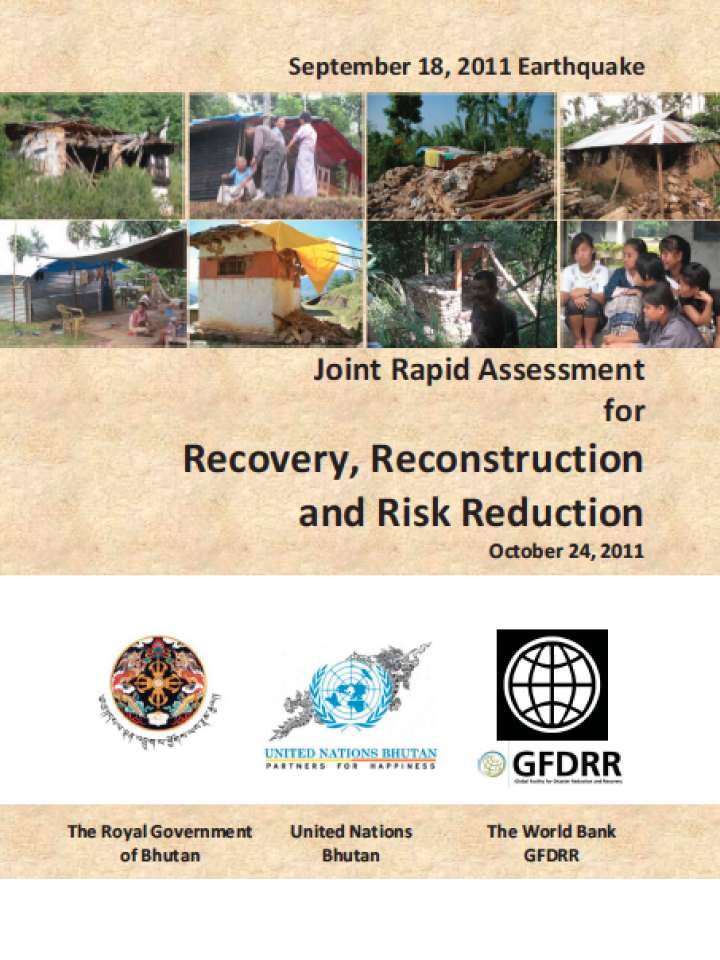
This Joint Rapid Assessment presents an assessment of the damage and loss following the 2011 earthquake in Bhutan. A framework for early recovery, reconstruction, and disaster risk reduction is also presented in the latter section of this Assessment.
Bhutan - government
Global Facility for Disaster Reduction and Recovery, the (GFDRR)
This journal focuses on the environment and disaster related issues in the Asian region. It provides a forum to communicate research findings, not only through academic research, but also incorporating field based action research. It aims to establish
This issue invites Haitians to look at the past to analyse their country’s present situation and to consider what should come next. It highlights UNESCO's commitment to support Haiti's recovery and reconstruction
United Nations Educational, Scientific and Cultural Organization (UNESCO)
This latest edition of the the Core Commitments for Children in Humanitarian Action – the CCCs – brings UNICEF’s humanitarian policy in line with evolving humanitarian contexts, including humanitarian reform and the cluster approach, informed by field