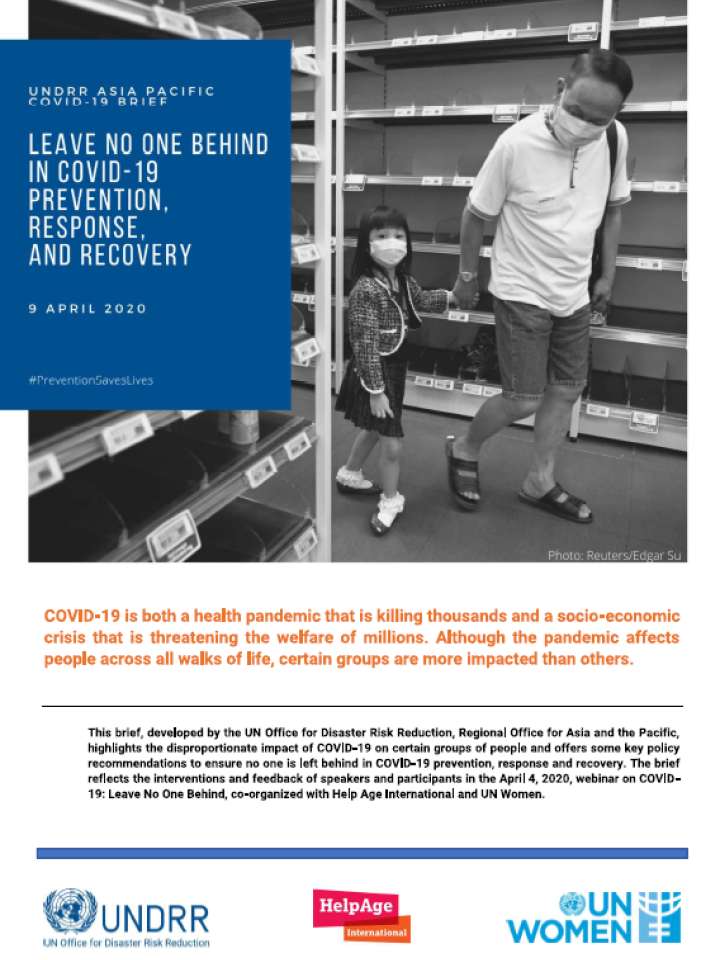
This brief highlights the disproportionate impact of COVID-19 on certain groups of people and offers some key policy recommendations to ensure no one is left behind in COVID-19 prevention, response and recovery.
United Nations Office for Disaster Risk Reduction - Regional Office for Asia and Pacific
On 6th December, the Government of Albania requested support from the European Union, the United Nations, and the World Bank to undertake a full and comprehensive PDNA to identify the damage, losses, and recovery needs arising from the earthquake.
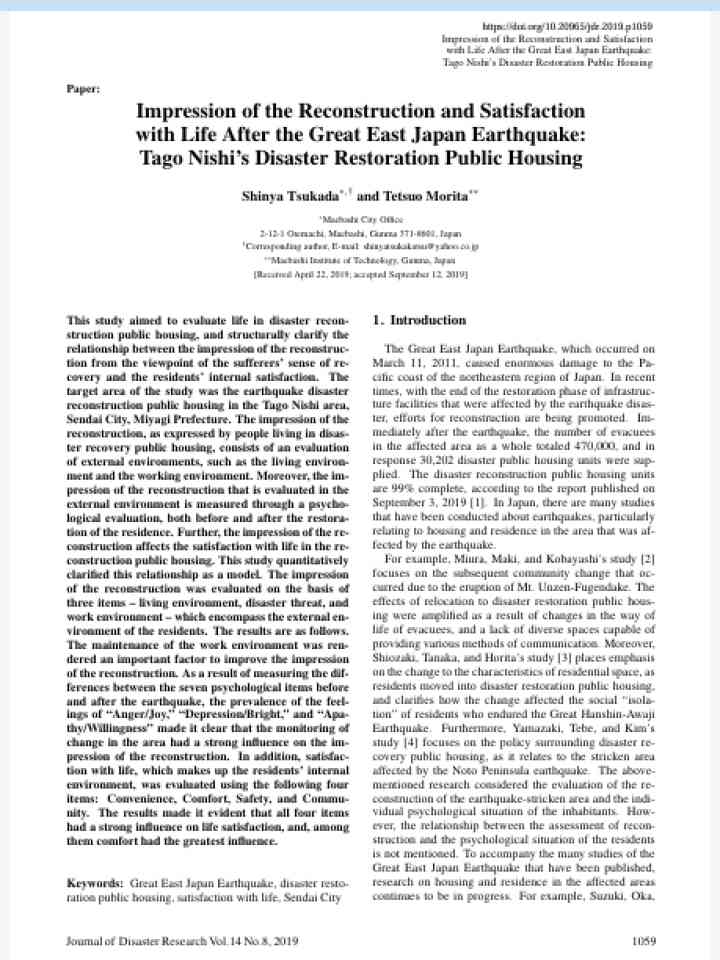
This study examined life in disaster reconstruction public housing and clarified how residents’ impressions of reconstruction relate to their sense of recovery and internal satisfaction.
Disasters place affected populations in great danger. Only in recent years have we recognized the importance of emotional impact and its short, median, and longterm consequences. Children and adolescents are an especially vulnerable group, since the
The village/town-university collaboration provides the Sendai Framework for Disaster Risk Reduction with a model for developing a multi-disciplinary and multi-hazard approach to public DRR policy during the recovery phase of a nuclear accident.
United Nations Office for Disaster Risk Reduction (UNDRR)
This predominantly qualitative research into long-term disaster resilience identifies what helps and hinders individual and community resilience in disasters. It documents the experiences and wisdom of 56 disaster survivors nine years after the 2009 Black
This study explores the perceptions of health effects and support received by people affected by the 2011 southeast Queensland flood six years after the event.
Australian Institute for Disaster Resilience (AIDR)
In the aftermath of the worst flooding Kerala has experienced in nearly a century, this document highlights the urgency of considering the long-term health consequences of floods, especially on young children.
This Toolkit aims to serve as a resource to guide aging and disability networks in increasing their ability to plan for and respond to public health emergencies and disasters. For organizations already engaged in emergency planning, this Toolkit can help expand and improve their capabilities.
National Association of County and City Health Officials