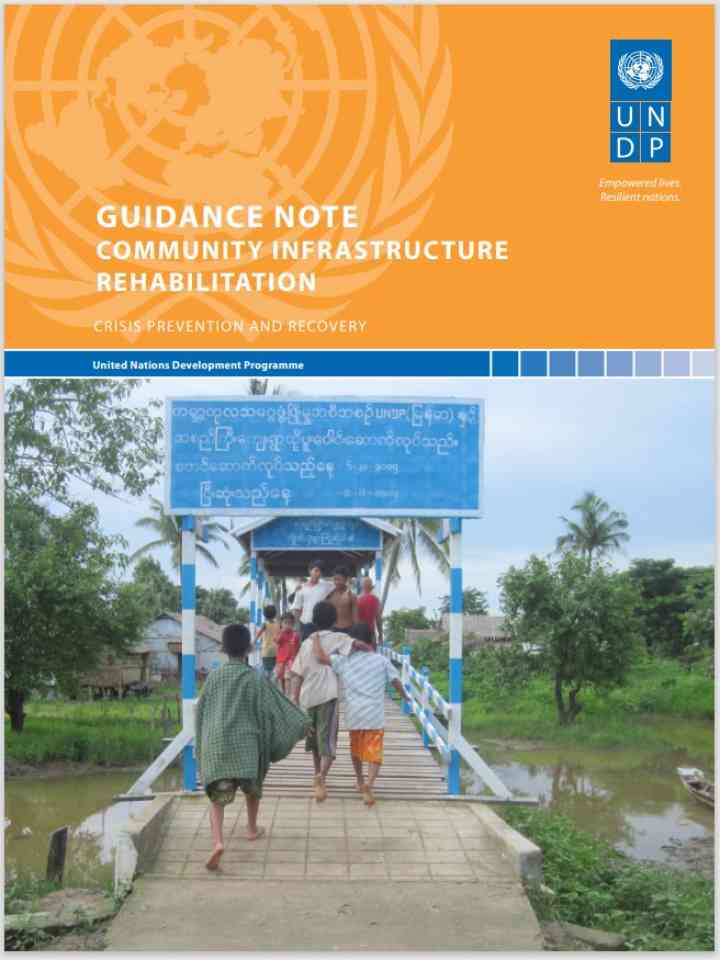
This provides practical advice on how to plan, design and implement a short-term project that swiftly links governments and communities in the assessment, repair and reconstruction of essential community infrastructure.
This publication provides guidance from experience with integrating cross-cutting issues into post-tsunami recovery efforts, and synthesizes valuable analyses, ideas, lessons learnt and recommendations.
This document presents the main outcomes, shared lessons and proceedings from the forum on post-disaster recovery organized by ADB in Manila on 20–21 October 2015. This forum provided a venue to share common challenges and possible solutions on planning and managing recovery programs based on lessons and good practices.
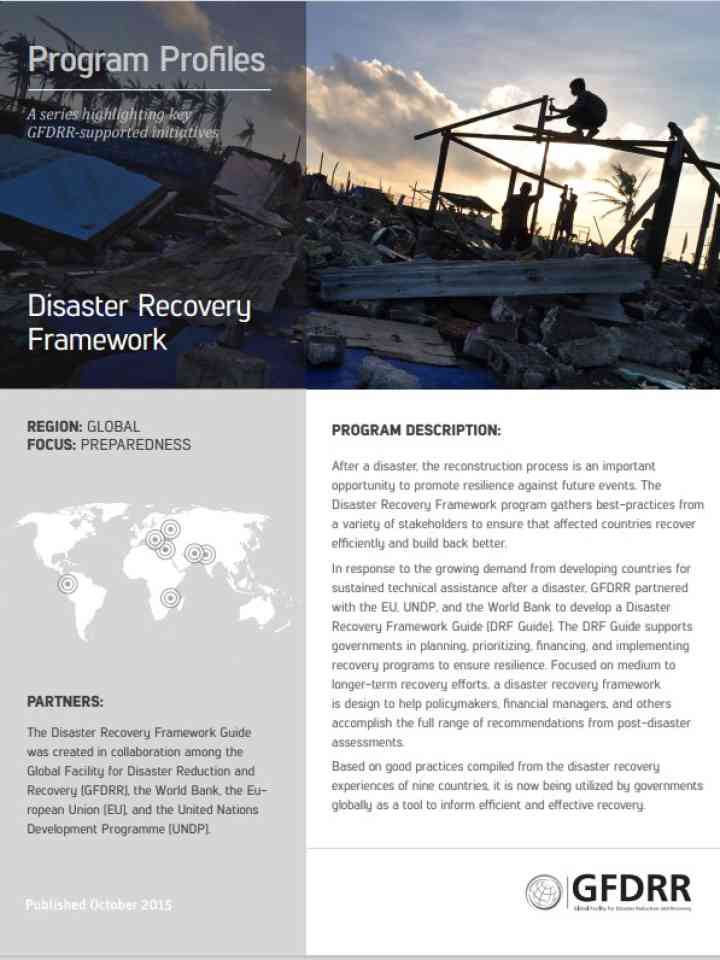
This is an overview of the Disaster Recovery Framework Programme, which collects best practices from various stakeholders to help affected countries recover efficiently and build back better after disasters.
World Bank, the
Global Facility for Disaster Reduction and Recovery, the (GFDRR)
Drought-affected communities in 3 Papua New Guinea provinces were assessed in Sept-Oct 2015, alongside a rapid gender analysis. This report summarizes needs, capacities, and findings on food security, WASH, livelihoods, health, coping, and recovery.
This report focuses on the first five months after the Nepal Earthquakes of 2015 and reviews the current legal and institutional framework for disaster risk management in Nepal and highlights its gaps and limitations in the context of the recent disaster.
This Housing Subsector study was performed in order to collect and analyze important information regarding the housing-related needs and priorities of the people affected by the 2015 Gorkha earthquake in Mercy Corps’ areas of intervention.
This book identifies and recommends recovery practices and novel programs most likely to impact overall community public health and contribute to resiliency for future incidents. It makes the case that disaster recovery should be guided by a healthy community vision, where health considerations are integrated into all aspects of recovery planning before and after a disaster, and funding streams are leveraged in a coordinated manner and applied to health improvement priorities.
This edition adds new insights to the original text of the 1982 Guidelines , provides a more updated format and gives updated resources and reflects current thinking within the shelter sector.
United Nations Office for the Coordination of Humanitarian Affairs
International Federation of Red Cross and Red Crescent Societies (IFRC)