Navigation failed to load. If you are on the UNDRR office network, your browser may be blocking access to external resources. Learn how to allow access.
The strong main shock of the Great East Japan Earthquake (GEJE) of March 11, 2011, caused little damage to buildings. This document is a knowledge note for structural measures of building performance.
World Bank, the
Global Facility for Disaster Reduction and Recovery, the (GFDRR)
This PDNA presents the findings of the Post-Disaster Needs Assessment (PDNA) conducted in Nigeria following the floods in 2012, from a comprehensive assessment of economic and social impacts, and recommendations for recovery and long-term resilience.
World Bank, the
Global Facility for Disaster Reduction and Recovery, the (GFDRR)
This report provides a detailed breakdown of economic losses and damage caused by severe flooding and landslides in the Seychelles, and the nearby islands of Praslin and La Digue, after heavy rains resulting from tropical cyclone Felleng on January 2013.
World Bank, the
Global Facility for Disaster Reduction and Recovery, the (GFDRR)
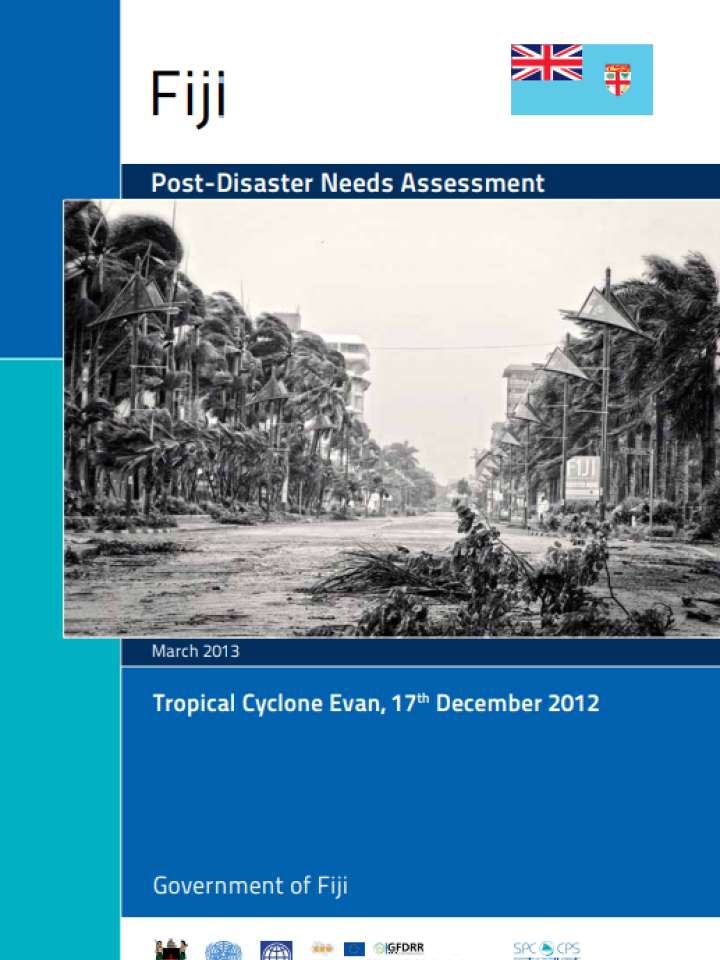
This PDNA takes stock of physical damage to property, infrastructure, and productive assets as well as to account for losses resulting from the disruption of economic flows brought on by the 2012 Tropical Cyclone Evan.
This case study presents emergency management practices in place for the city of Wellington, and discusses all hazards approach and different phases of the comprehensive emergency management concept.
Nepal’s national action plan on disaster management consists of four main plans on: disaster preparedness, disaster response, disaster reconstruction and rehabilitation action, and disaster mitigation. The plan is presented in the form of a matrix indicating priority item groups, activities, time schedule, and executing agencies.
This paper presents Japan’s natural and social conditions subject to occurrence of natural disasters and outlines countermeasures for disaster prevention such as integrated flood control, forest conservation and erosion control, and earthquake disaster countermeasures. The document discusses country’s basic legal and institutional framework and related plans for disaster prevention and describes recovery, relief and international cooperation activities.
This document describes disaster conditions in Japan, presents legal and institutional framework and disaster prevention plans, and discusses current major disaster prevention measures related to research and development, preparedness, national land conservation, emergency and recovery.
This document is an outcome of the 2010 course "First aid to cultural heritage in time of conflict", which aimed to create a framework to secure cultural heritage in such times.
International Centre for the Study of the Preservation and Restoration of Cultural Property
This paper outlines key lessons related to the design and implementation of urban disaster-response programmes. It focuses on the response and early recovery phases of an urban emergency, and on natural disasters such as earthquakes and flooding.
Active Learning Network for Accountability and Performance (ALNAP)