Navigation failed to load. If you are on the UNDRR office network, your browser may be blocking access to external resources. Learn how to allow access.
This guide provides a set of local economy recovery guidelines that are designed to stimulate employment creation and facilitate reintegration in post-conflict societies.
The priorities of the Post-Earthquake Action Plan are to cope immediately with the emergency, restart economic, governmental and social activities, reduce the vulnerabilities of the country and once again put Haiti on the path of development.
This document reports on an opinion poll undertaken with the objective of defining Haitians' perception (from diverse social classes) on several topics related to the post-earthquake situation. It is intended to help develop advocacy and appeal tools in order to help local, state, and non-state actors take ownership of post-earthquake reconstruction processes.
This report aims to scale-up women’s participation in recovery and reconstruction of Haiti and asserts that gender equality principles must guide all aspects of disaster mitigation, response and reconstruction. It is a response to Haiti’s National Plan of Action, the blueprint guiding reconstruction efforts and resource allocation, based on a Post-Disaster Needs Assessment (PDNA), resulting from a two month process led by the Government of Haiti and involving more than 250 people from the United Nations, the World Bank, the European Union and the Inter-American Development Bank, but failing to address gender dimensions of Haiti’s proposed strategies for reconstructing macroeconomic, social, environmental policies, as well as infrastructure and governance.
Huairou Commission
Grassroots Organizations Operating Together in Sisterhood
This paper is calling for the Government of Haiti and the international community to focus on reducing the impact of future disasters. It asserts that Haiti’s disasters cannot be prevented, but that their effects on the people who live here can be minimised by investments in pre-disaster preparedness and disaster risk reduction (DRR), and that DRR must be treated as a critical component of any reconstruction and recovery framework for the country.
The purpose of this report is to document innovative post‐disaster recovery strategies to provide structure and context for potential inclusion of such efforts as part of the CRS program.
This study provides an overview and guidelines for rehabilitation of mangroves and other coastal forests. The guidelines include the rationale for rehabilitation; choice of species; site selection and preparation; propagation and planting; monitoring and tending; and case studies.
These three sectoral reports were produced to complete the Malaysian National slope master plan 2009-2023 with the aim of formulating a detailed, comprehensive and effective framework of policies, strategies and action plans to reduce risks from landslides on slopes nationwide. The plan included activities at the national, state and local levels in both the public and private sectors.
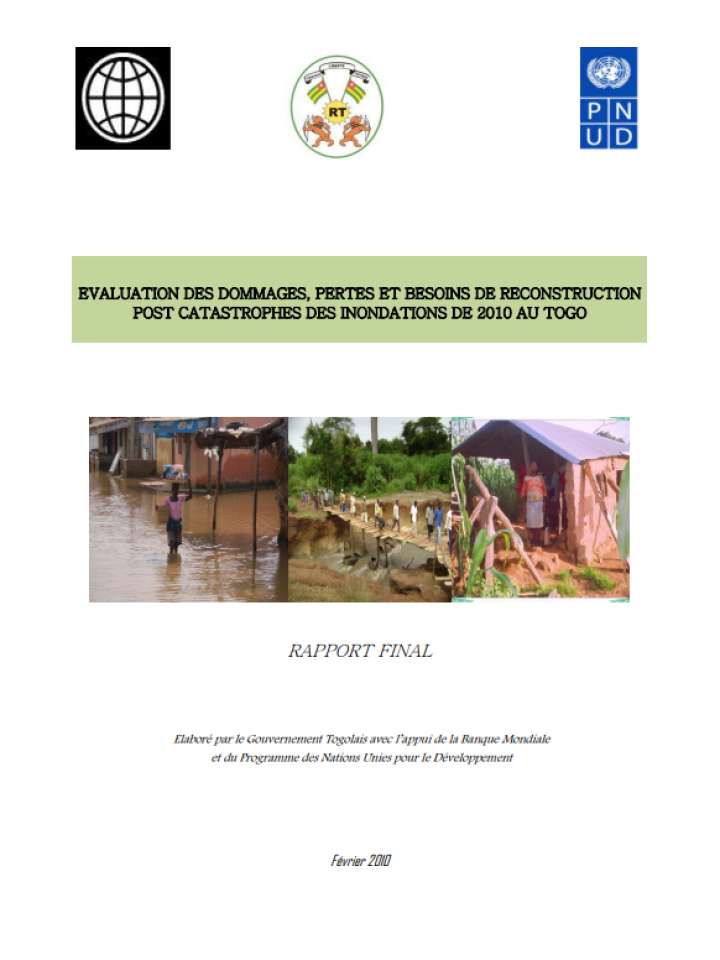
This post-disaster needs assessment is intended to conduct a socio-economic analysis to assess the damage, losses and reconstruction needs after the 2010 floods in Togo.
Togo - government
World Bank, the
Global Facility for Disaster Reduction and Recovery, the (GFDRR)
This document reviews how Nicaragua has recovered from Hurricane Mitch over the past ten years. The focus is on how relevant the assumptions and claims that were made in the initial recovery planning have been in light of subsequent development.
Stockholm Environment Institute
ProVention Consortium
Glemminge Development Research AB
Institute of Applied Research and Local Development