This study focuses on the 2006 landslide tragedy in the Philippines, where an entire community, including its people, its productive assets, and its socio-cultural resources, was totally buried. It reports on the various levels of recovery that have been achieved among the provision of community services and facilities such as health, education, recreation, infrastructure, livelihood opportunities and psychosocial services; and identifies the limitations of the principle of "build back better" as well as those areas of concern in which the principle can best be applied.
This report provides insights and recommendations for enhancing tsunami evacuation procedures based on observations and interviews conducted in tsunami-affected areas following the Great East Japan earthquake and tsunami of March 11th, 2011.
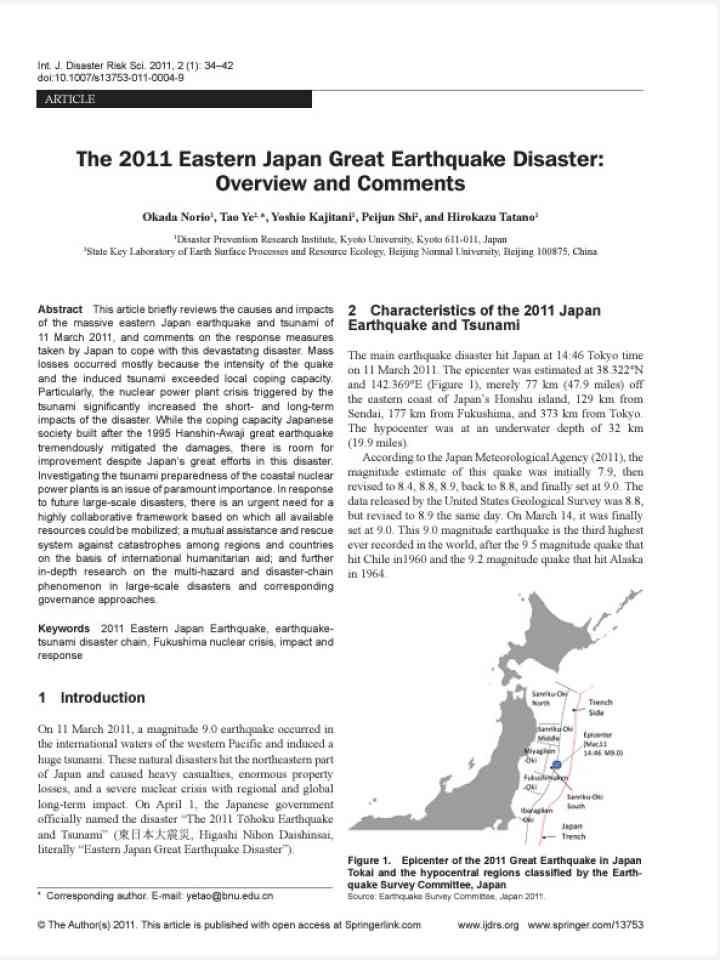
This article briefly reviews the causes and impacts of the massive eastern Japan earthquake and tsunami of 11 March 2011, and comments on the response measures taken by Japan to cope with this devastating disaster.
These guidelines help to describe the main elements of a recovery programming approach required to deliver high-quality, timely and accountable humanitarian assistance.
International Federation of Red Cross and Red Crescent Societies (IFRC)
This review analyses some of the major events and trends related to natural disasters and humanitarian disaster response and looks at the experience of developed countries with natural disasters in 2011.
This paper explains the parametric insurance system of the Caribbean Catastrophe Risk Insurance Facility (CCRIF) in the event of a hurricane or an earthquake.
Caribbean Catastrophe Risk Insurance Facility, the
This paper explains the excess rainfall parametric insurance product of the CCRIF and Swiss Re Excess Rainfall, which helps to mitigate the short-term cash flow problems small developing economies suffer after major natural disasters.
Caribbean Catastrophe Risk Insurance Facility, the
This document is the final report of the Commission of Inquiry into the Queensland floods of 2010/2011, established following the flooding of historic proportions in Queensland in December 2010, stretching into January 2011. It embodies both likelihood of
This report examines Haiti’s legal framework for facilitating and regulating international disaster assistance in the light of the IDRL Guidelines and the experience with the international response to the 2010 earthquake. It sets out recommendations for
International Federation of Red Cross and Red Crescent Societies (IFRC)