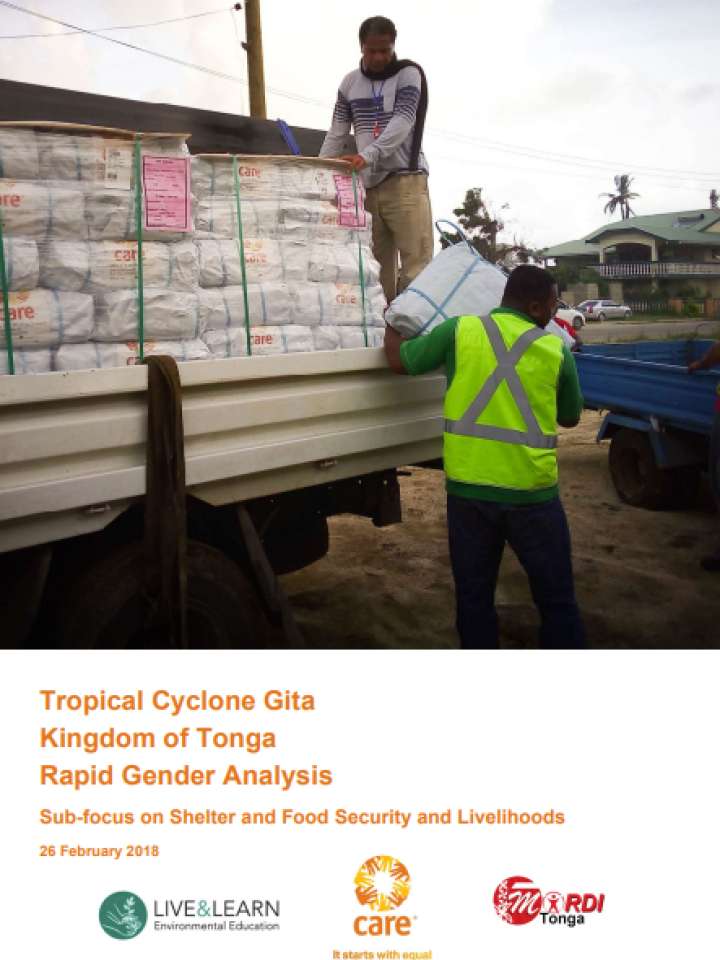
This rapid gender analysis is designed to provide initial information about gender roles, responsibilities, capacities and vulnerabilities of women, men, girls and boys, SOGIE and other marginalised people prior to and after TC Gita.
This research was motivated by the lack of reconstruction progress in urban settlements one year after the earthquakes and conducted ethnographic fieldwork in five urban settlements over a period of 18 months.
International Institute for Environment and Development (IIED)
This working paper presents the findings from a pilot research project that investigated how disaster-affected households in low- and middle-income countries rebuild their homes in situations where little or no support is available from humanitarian agencies. The project was an interdisciplinary collaboration involving social scientists, geoscientists, structural engineers and humanitarian practitioners.
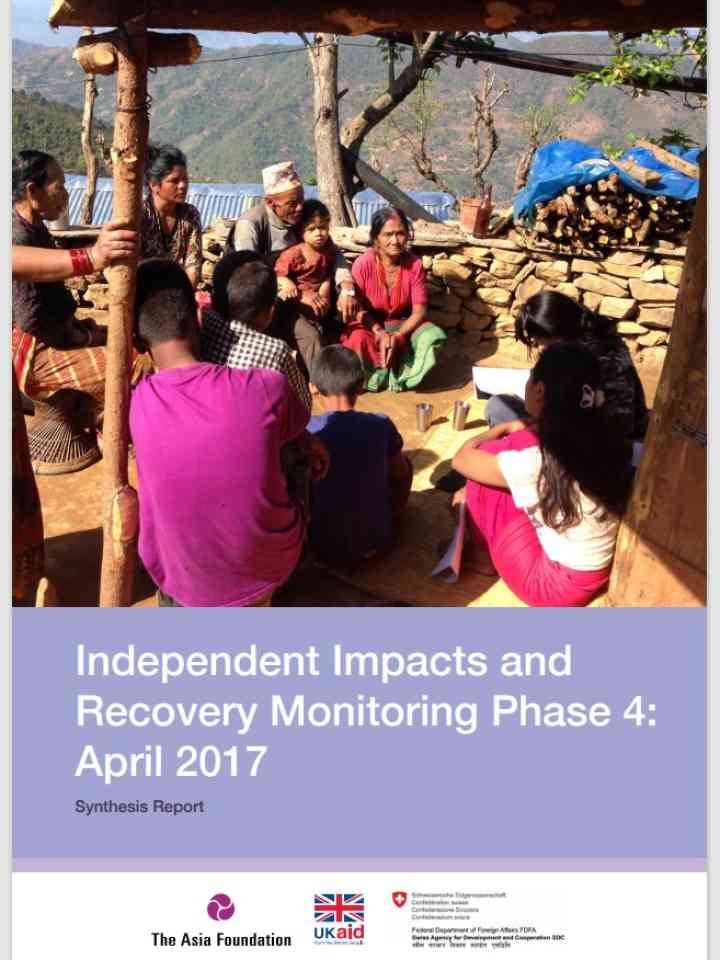
2 years after earthquakes hit Nepal in 2015, the IRM completed its 4th round of research to track how people are recovering, what aid has been provided and how effective it has been, and which groups are being left behind.
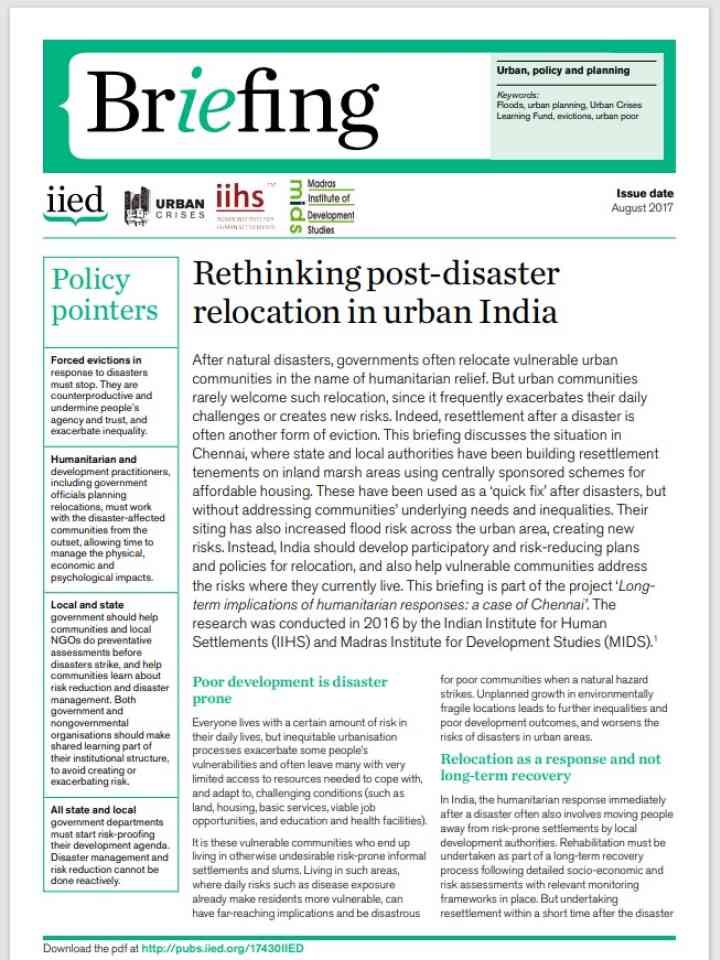
This briefing is part of the project 'Longterm implications of humanitarian responses: a case of Chennai'. The research was conducted in 2016 by the Indian Institute for Human Settlements (IIHS) and Madras Institute for Development Studies (MIDS).
International Institute for Environment and Development (IIED)
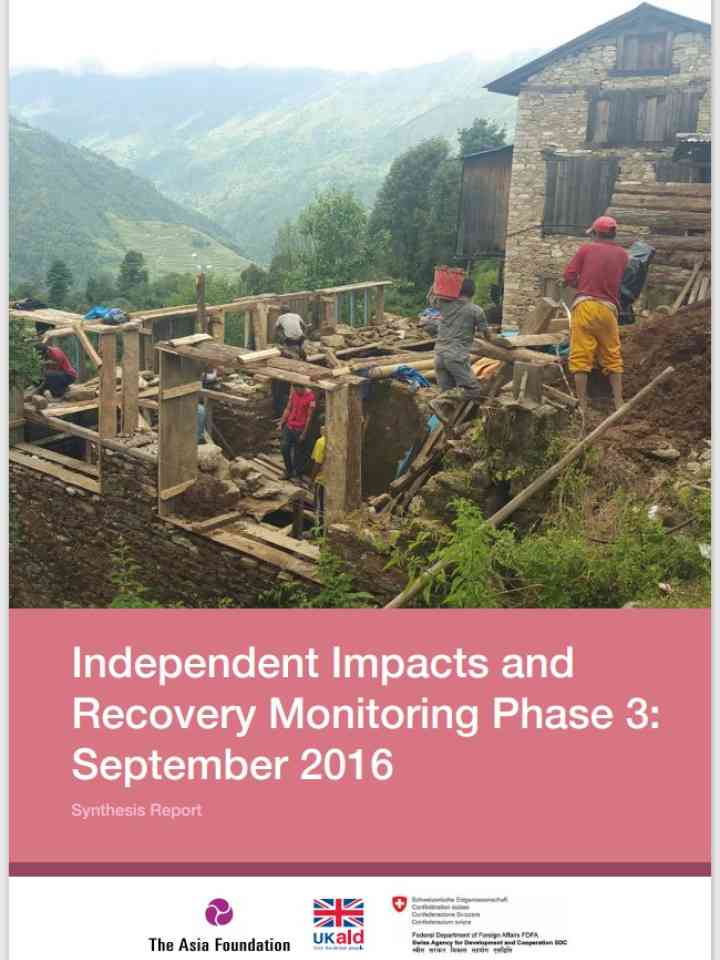
18 months from the earthquakes hit Nepal in 2015, the third wave of the IRM tracks the extent to which people have recovered, what coping strategies they are using and how effective they are, how aid is helping and which groups are being left behind.
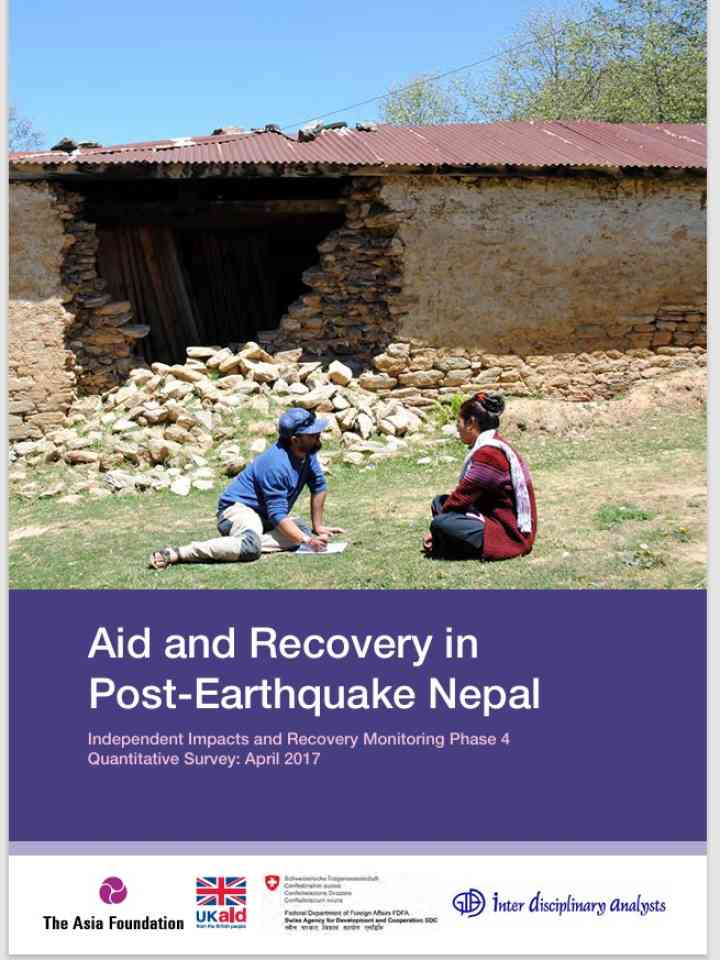
This report provides findings from the fourth in a series of large-scale surveys, conducted in April 2017, two years on from the devastating earthquakes that hit Nepal.
This provides a detailed examination of the challenges, strategies, and best practices in housing recovery efforts following disasters, emphasizing the importance of governance structures, community engagement, and equitable distribution of resources.
Oxford Research Encyclopedia of Natural Hazard Science
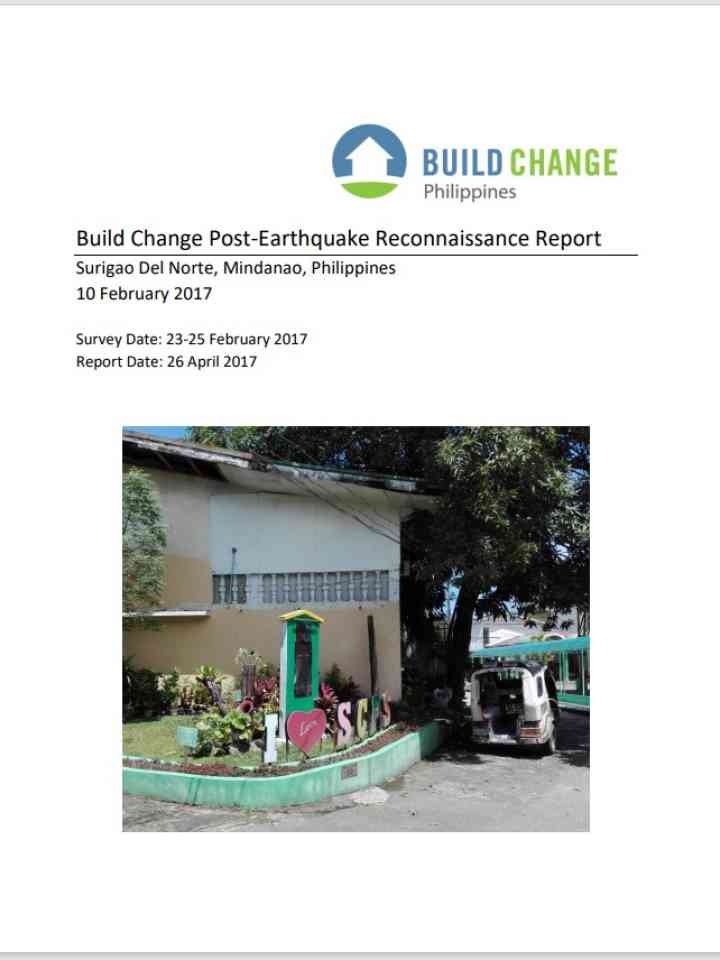
Following the magnitude 6.7 Surigao earthquake in February 2017, Build Change sent a technical reconnaissance team to observe damaged and undamaged houses and schools.