AECOM (provider of services for infrastructure projects) was engaged by the Tasmanian Department of Premier and Cabinet Climate Change Office (TCCO) to develop a suite of online and printable resources to help Tasmanian businesses across a range of
United Nations Office for Disaster Risk Reduction (UNDRR)
This publication describes recent national disaster mechanism experiences in the housing sector that best reflects the situation in Malaysia and that are in line with international practice. The objective of the papers is to know how to better support
The main objective of the study is to analyze the impact of the disaster in the urban sector and thereby help to the development of an urban housing recovery and reconstruction policy.
This paper seeks to inform policy changes that can be considered in the post 2015 framework for disaster risk reduction, drawing lessons from the Christchurch earthquake in New Zealand and the Great Eastern Japan earthquake and tsunami in 2011. Both events offer the opportunity for researchers and practitioners to review current practice in disasters response and information sharing.
World Bank, the
United Nations Office for Disaster Risk Reduction (UNDRR)
In the context of housing reconstruction in the Philippines in the aftermath of tropical storm Washi, this research explores how to effectively manage resettlement projects.
This publication presents the Yonmenkaigi System Method, a participatory method for creating collaborative action plans for community building to improve disaster restoration. The method comprises four stages:
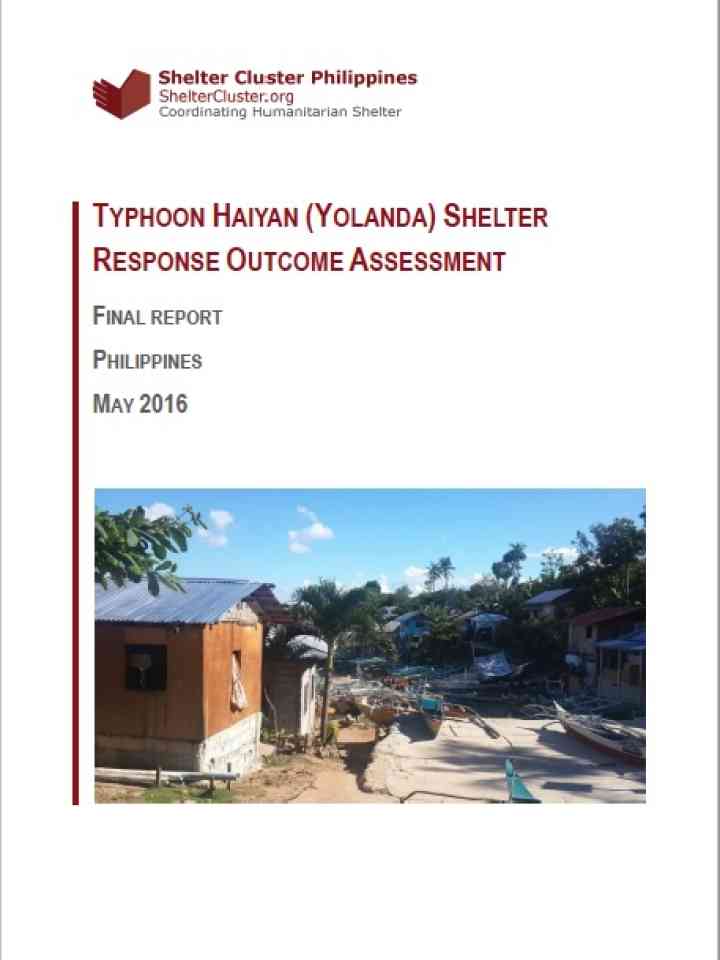
Planned and implemented with the Global Shelter Cluster and operational shelter in the Philippines, this report examines some of the characteristics influencing shelter recovery after Typhoon Haiyan.
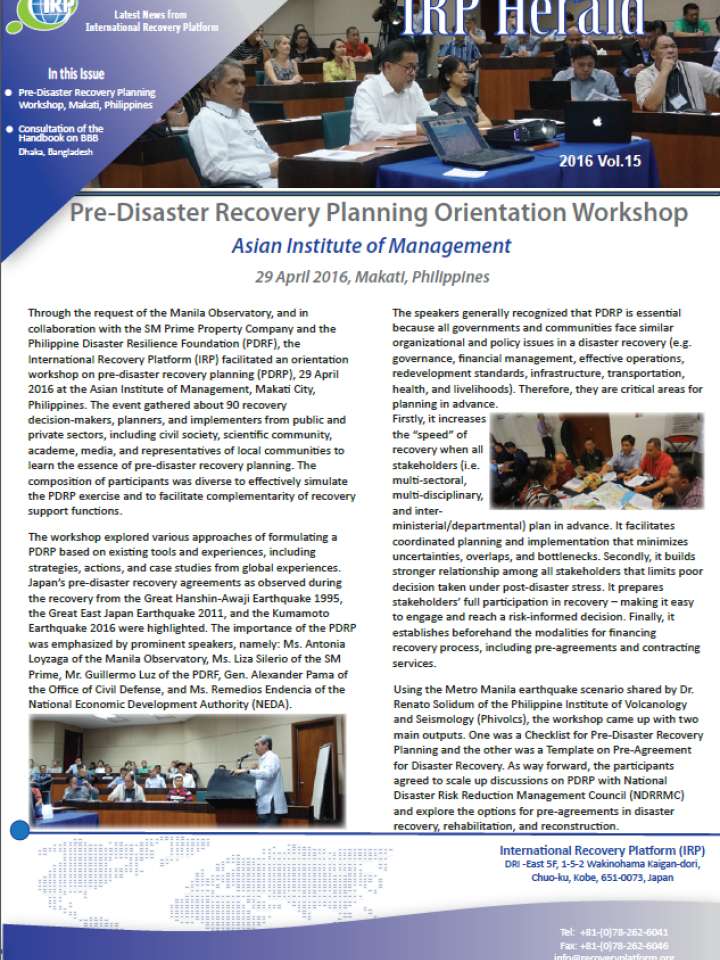
IRP Herald Volume 15 is the knowledge report for the Pre-Disaster Recovery Planning (PDRP) Orientation Workshop facilitated by the IRP at the Asian Institute of Management, as well as the Consultation of the Handbook on Build Back Better in Recovery.